Chapter guides › Class 10 maths
CBSE Class 10 maths · Chapter 5
Arithmetic Progressions
Lists that grow by a fixed amount: the common difference, the nth term, and the sum of the first n terms.
- NCERT Chapter 5
- 3 interactive lessons
- Endless practice
- Board-style test
About this chapter
Arithmetic Progressions is Chapter 5 of CBSE Class 10 maths. An AP is a list where each term is the previous one plus a fixed number d, like 26, 22, 18, … (d = −4) or a monthly saving that grows by ₹50.
The chapter gives a formula for any term without listing them all, and a formula for the sum of the first n terms, the famous trick a young Gauss used to add 1 to 100. Board papers ask which term has a given value, whether a number is in the list at all, and sums of logs, seats or savings.
Key results and formulas
- Common difference
- d = a₂ − a₁ (the same between every pair of neighbouring terms)
- nth term
- aₙ = a + (n − 1)d
- Sum of the first n terms
- Sₙ = n/2 × [2a + (n − 1)d]
- Sum when the last term l is known
- Sₙ = n/2 × (a + l)
- Three terms in AP
- a, b, c are in AP when 2b = a + c.
- A term from the sums
- aₙ = Sₙ − Sₙ₋₁
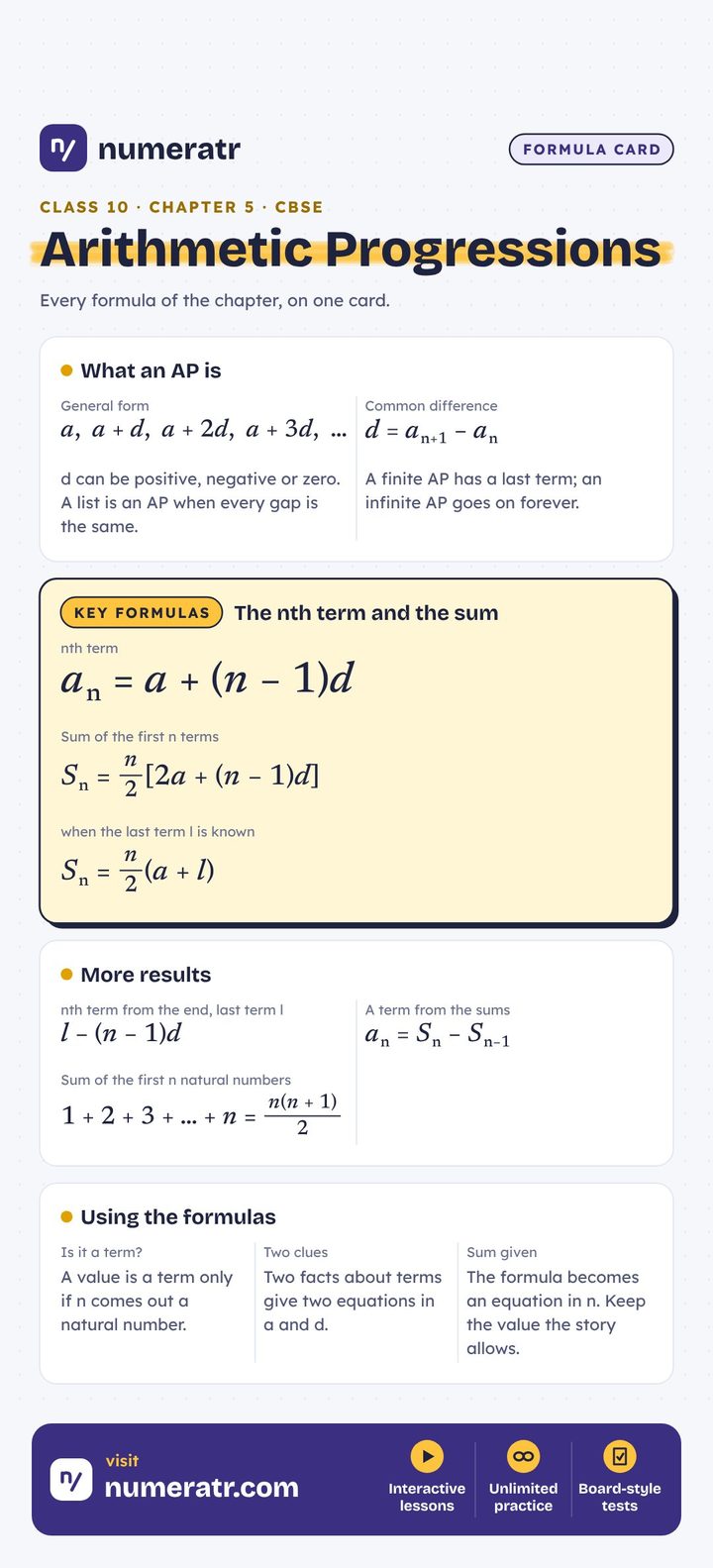
Every formula of Arithmetic Progressions on one card
A free revision card, made to be saved and shared. It covers:
- Common difference
- nth term
- Sum of the first n terms
- Sum when the last term l is known
- Three terms in AP
- A term from the sums
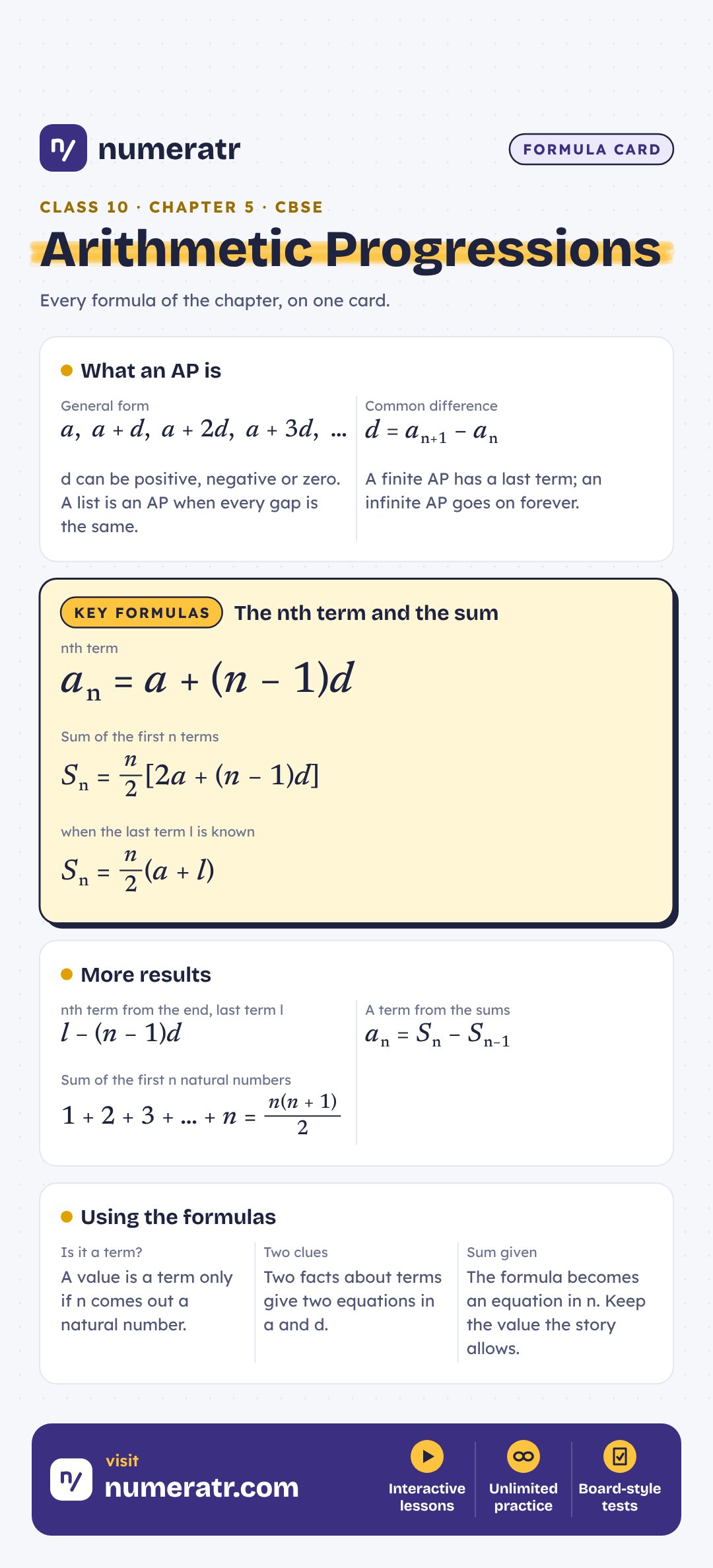
Free to share with friends and study groups.
Learn, practise, test
Every chapter on Numeratr follows the same three steps.
- 1Learn
Short stories and animated pictures explain each idea. After every idea, your child tries a question.
- 2Practise
Practice that adapts from Easy to Challenge, by pattern, or ten at a time. Hints and a full solution for every question.
- 3Test
A board-style chapter test, sections A to E like the board paper. Fresh numbers every time.
Try three questions
From a starter to a challenge. Have a go before you open the answer.
Which term of the AP 26, 22, 18, … is −46?
Show the answerHide the answer
the 19th term
- a = 26 and d = −4.
- 26 + (n − 1)(−4) = −46 gives (n − 1)(−4) = −72, so n − 1 = 18.
- n = 19: the 19th term is −46.
How many three-digit numbers are divisible by 13?
Show the answerHide the answer
69
- The three-digit multiples of 13 are 104, 117, …, 988, an AP with d = 13.
- 104 + (n − 1) × 13 = 988 gives (n − 1) × 13 = 884, so n − 1 = 68.
- There are 69 such numbers.
Find 60² − 59² + 58² − 57² + … + 2² − 1².
Show the answerHide the answer
1830
- Each pair is a difference of squares: 60² − 59² = 119, 58² − 57² = 115, …, 2² − 1² = 3.
- So the sum is 119 + 115 + … + 3, an AP with 30 terms and d = −4.
- Sum = 30/2 × (119 + 3) = 15 × 122 = 1830.
Learn Arithmetic Progressions the right way
Interactive lessons, endless practice that adapts, and tests with a fresh paper every time. Children earn NerdCoins for real effort, and parents get a clear report.
One chapter in every class is free.