Chapter guides › Class 10 maths
CBSE Class 10 maths · Chapter 3
Pair of Linear Equations in Two Variables
Two equations, two unknowns: what a solution is, solving by graphs, the ratio test for consistency, substitution and elimination, and word problems.
- NCERT Chapter 3
- 4 interactive lessons
- Endless practice
- Board-style test
About this chapter
Pair of Linear Equations in Two Variables is Chapter 3 of CBSE Class 10 maths. Each equation, like 3x + y = 11, is a straight line; a solution of the pair is a point on both lines.
Two lines can cross, run parallel or lie on top of each other, so a pair has one solution, none or infinitely many. The chapter shows how to tell which from the coefficients alone, how to solve by substitution and elimination, and how to turn word problems about costs, ages, digits, speeds and boats into a pair of equations.
Key results and formulas
- Standard form
- a₁x + b₁y + c₁ = 0 and a₂x + b₂y + c₂ = 0
- One solution (lines cross)
- a₁/a₂ ≠ b₁/b₂
- No solution (parallel lines)
- a₁/a₂ = b₁/b₂ ≠ c₁/c₂
- Infinitely many solutions (same line)
- a₁/a₂ = b₁/b₂ = c₁/c₂
- Substitution
- Make one letter the subject of one equation and put it into the other.
- Elimination
- Multiply so one letter has the same coefficient in both equations, then add or subtract to remove it.
Every formula of Pair of Linear Equations in Two Variables on one card
A free revision card, made to be saved and shared. It covers:
- Standard form
- One solution (lines cross)
- No solution (parallel lines)
- Infinitely many solutions (same line)
- Substitution
- Elimination
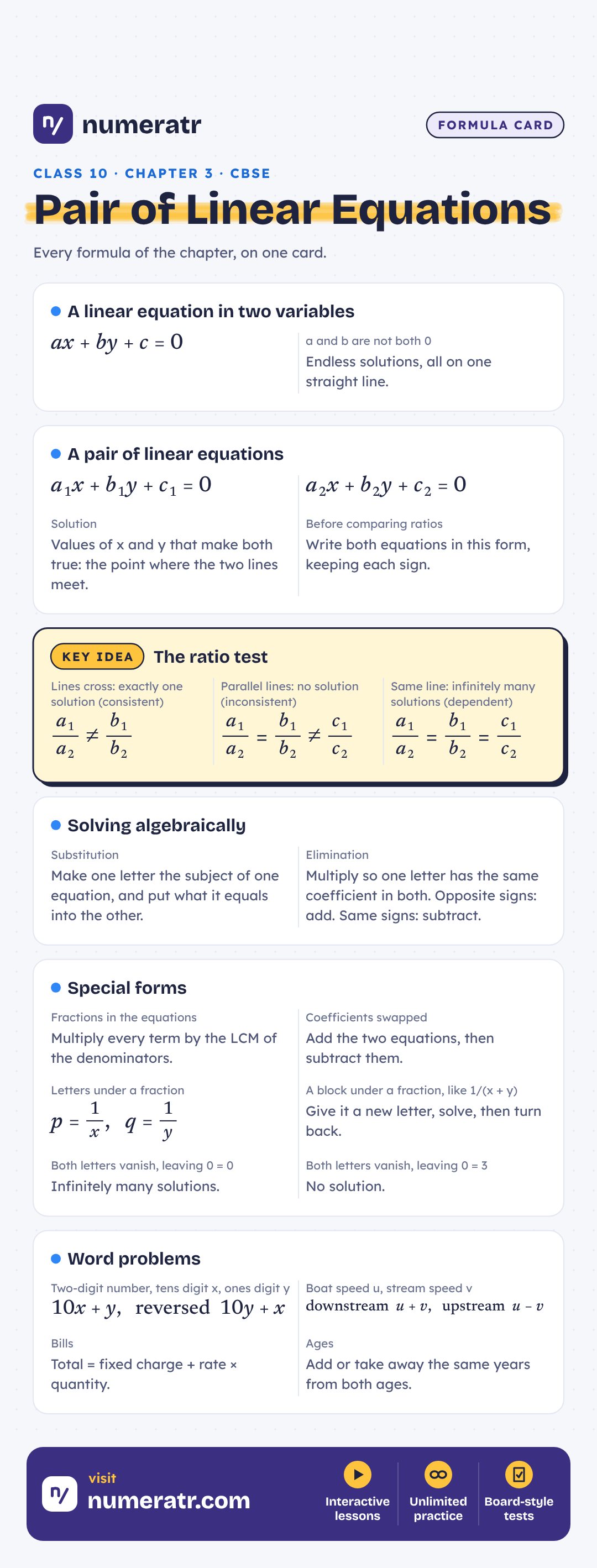
Free to share with friends and study groups.
Learn, practise, test
Every chapter on Numeratr follows the same three steps.
- 1Learn
Short stories and animated pictures explain each idea. After every idea, your child tries a question.
- 2Practise
Practice that adapts from Easy to Challenge, by pattern, or ten at a time. Hints and a full solution for every question.
- 3Test
A board-style chapter test, sections A to E like the board paper. Fresh numbers every time.
Try three questions
From a starter to a challenge. Have a go before you open the answer.
The sum of two numbers is 27 and their difference is 5. Find the smaller number.
Show the answerHide the answer
11
- x + y = 27 and x − y = 5.
- Subtracting: 2y = 22, so y = 11 and x = 16.
- The smaller number is 11.
Find a if the pair 2x + 3y = 7 and (a − 1)x + (a + 2)y = 3a has infinitely many solutions.
Show the answerHide the answer
7
- Infinitely many solutions need 2/(a − 1) = 3/(a + 2) = 7/(3a).
- 2/(a − 1) = 3/(a + 2) gives 2a + 4 = 3a − 3, so a = 7.
- Check: the ratios are 2/6, 3/9 and 7/21, all equal to 1/3.
For what value of k do the lines 2x − y = 1, x + y = 5 and kx − 3y = 4 all pass through one point?
Show the answerHide the answer
13/2
- Solve the first two: adding gives 3x = 6, so x = 2 and y = 3.
- The third line must pass through (2, 3): 2k − 9 = 4.
- So k = 13/2.
Learn Pair of Linear Equations in Two Variables the right way
Interactive lessons, endless practice that adapts, and tests with a fresh paper every time. Children earn NerdCoins for real effort, and parents get a clear report.
One chapter in every class is free.