Chapter guides › Class 10 maths
CBSE Class 10 maths · Chapter 2
Polynomials
What a polynomial is, its zeroes, factorising quadratics, the graphs of polynomials, and how the zeroes hide in the coefficients, with worked examples and how Numeratr teaches it.
- NCERT Chapter 2
- 5 interactive lessons
- Endless practice
- Board-style test
- Free chapter
About this chapter
Polynomials is the second chapter of CBSE Class 10 maths. It is about expressions like 2x² + 5x − 3: what makes them polynomials, what their zeroes are, and how to find those zeroes.
The chapter links algebra and graphs: a zero is where the graph meets the x-axis. It ends with one of the most useful results in school algebra: for ax² + bx + c, the sum of the zeroes is −b/a and their product is c/a. Board papers use this to find unknown coefficients and to build a quadratic from its zeroes.
Key results and formulas
- Zero of a polynomial
- A number k is a zero of p(x) if p(k) = 0. On a graph, it is where the curve meets the x-axis.
- How many zeroes
- A polynomial of degree n has at most n zeroes: a linear one has 1, a quadratic at most 2, a cubic at most 3.
- Sum of the zeroes of ax² + bx + c
- α + β = −b/a
- Product of the zeroes of ax² + bx + c
- αβ = c/a
- A quadratic from its zeroes
- x² − (sum of zeroes)x + (product of zeroes), times any non-zero number k.
- Cubic ax³ + bx² + cx + d
- α + β + γ = −b/a, αβ + βγ + γα = c/a, αβγ = −d/a
- The a × c method
- To factorise ax² + bx + c, find two numbers with product a × c and sum b, then split the middle term.
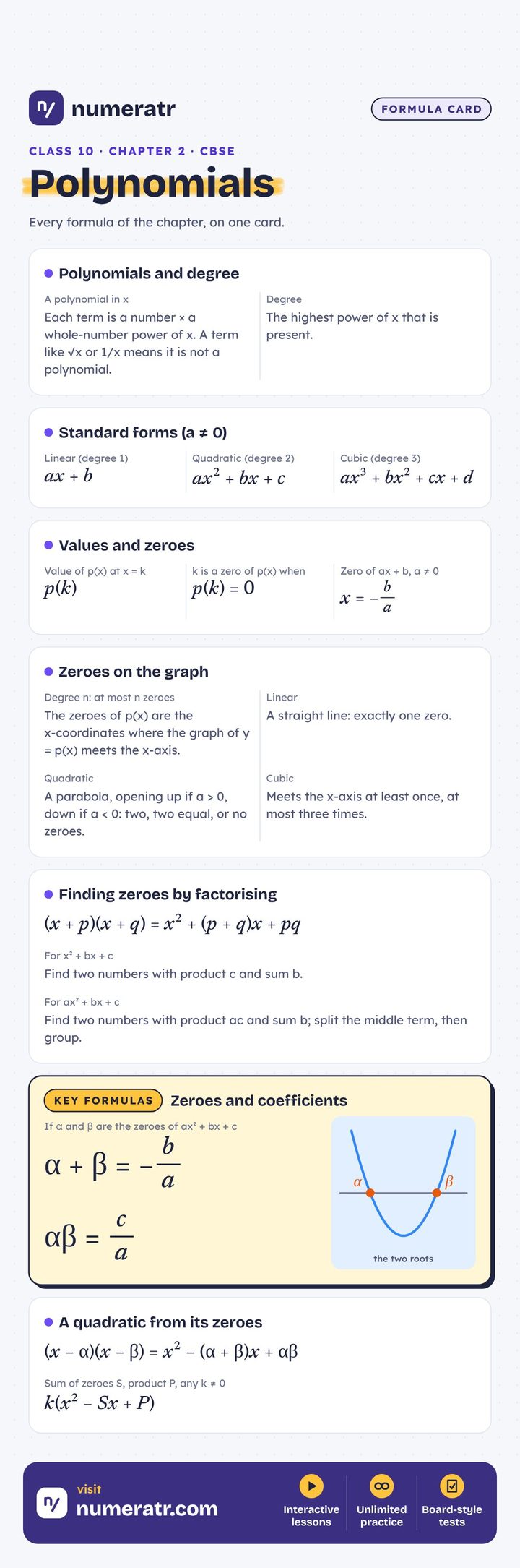
Every formula of Polynomials on one card
A free revision card, made to be saved and shared. It covers:
- Zero of a polynomial
- How many zeroes
- Sum of the zeroes of ax² + bx + c
- Product of the zeroes of ax² + bx + c
- A quadratic from its zeroes
- Cubic ax³ + bx² + cx + d
- The a × c method
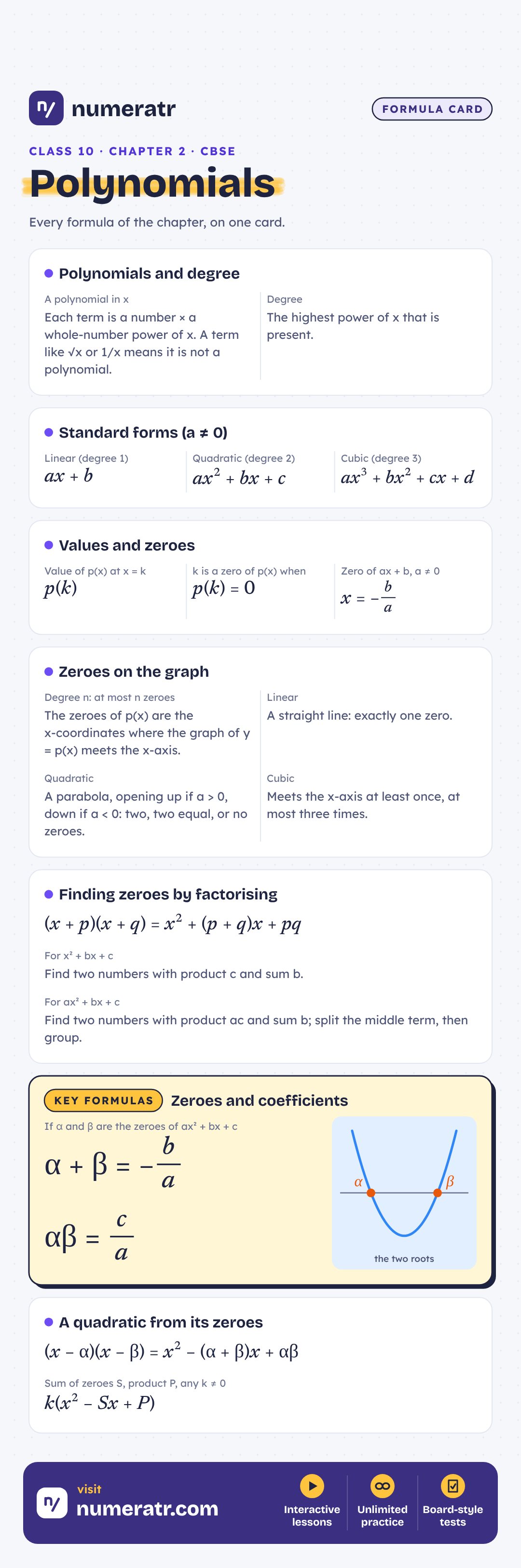
Free to share with friends and study groups.
Learn, practise, test
Every chapter on Numeratr follows the same three steps.
- 1Learn
Short stories and animated pictures explain each idea. After every idea, your child tries a question.
- 2Practise
Practice that adapts from Easy to Challenge, by pattern, or ten at a time. Hints and a full solution for every question.
- 3Test
A board-style chapter test, sections A to E like the board paper. Fresh numbers every time.
Try three questions
From a starter to a challenge. Have a go before you open the answer.
Find the sum of the zeroes of 3x² − 8x + 5.
Show the answerHide the answer
8/3
- For ax² + bx + c, the sum of the zeroes is −b/a.
- Here a = 3 and b = −8, so the sum is 8/3.
- Check: 3x² − 8x + 5 = (3x − 5)(x − 1), with zeroes 5/3 and 1, and 5/3 + 1 = 8/3.
One zero of x² − 15x + p is four times the other. Find p.
Show the answerHide the answer
36
- Let the zeroes be α and 4α.
- Sum: α + 4α = 5α = 15, so α = 3 and the zeroes are 3 and 12.
- Product: p = 3 × 12 = 36. Check: x² − 15x + 36 = (x − 3)(x − 12).
α and β are the zeroes of x² − 8x + k, and α² + β² = 40. Find k.
Show the answerHide the answer
12
- α + β = 8 and αβ = k.
- α² + β² = (α + β)² − 2αβ = 64 − 2k.
- 64 − 2k = 40 gives k = 12. Check: x² − 8x + 12 = (x − 2)(x − 6), and 4 + 36 = 40.
Learn Polynomials the right way
Interactive lessons, endless practice that adapts, and tests with a fresh paper every time. Children earn NerdCoins for real effort, and parents get a clear report.
This chapter is free: sign in and start.