Chapter guides › Class 10 maths
CBSE Class 10 maths · Chapter 14
Probability
The classical definition of probability, and problems with coins, dice, cards, balls and numbers.
- NCERT Chapter 14
- 2 interactive lessons
- Endless practice
- Board-style test
About this chapter
Probability is the last chapter of CBSE Class 10 maths. It measures how likely an event is, with a number from 0 (impossible) to 1 (sure).
When all outcomes are equally likely, the probability of an event is the number of favourable outcomes divided by the total. The chapter applies this to coins, dice, cards, numbered tokens and bags of balls, and to complementary events, where finding the chance something does not happen is often quicker.
Key results and formulas
- Probability of an event
- P(E) = number of favourable outcomes ÷ total number of outcomes
- Range
- 0 ≤ P(E) ≤ 1; an impossible event has 0, a sure event has 1.
- Complementary events
- P(not E) = 1 − P(E)
- Two coins, three coins
- 4 and 8 equally likely outcomes.
- Two dice
- 36 equally likely outcomes.
- A pack of cards
- 52 cards: 4 suits of 13; 12 face cards; 26 red and 26 black.
Every formula of Probability on one card
A free revision card, made to be saved and shared. It covers:
- Probability of an event
- Range
- Complementary events
- Two coins, three coins
- Two dice
- A pack of cards
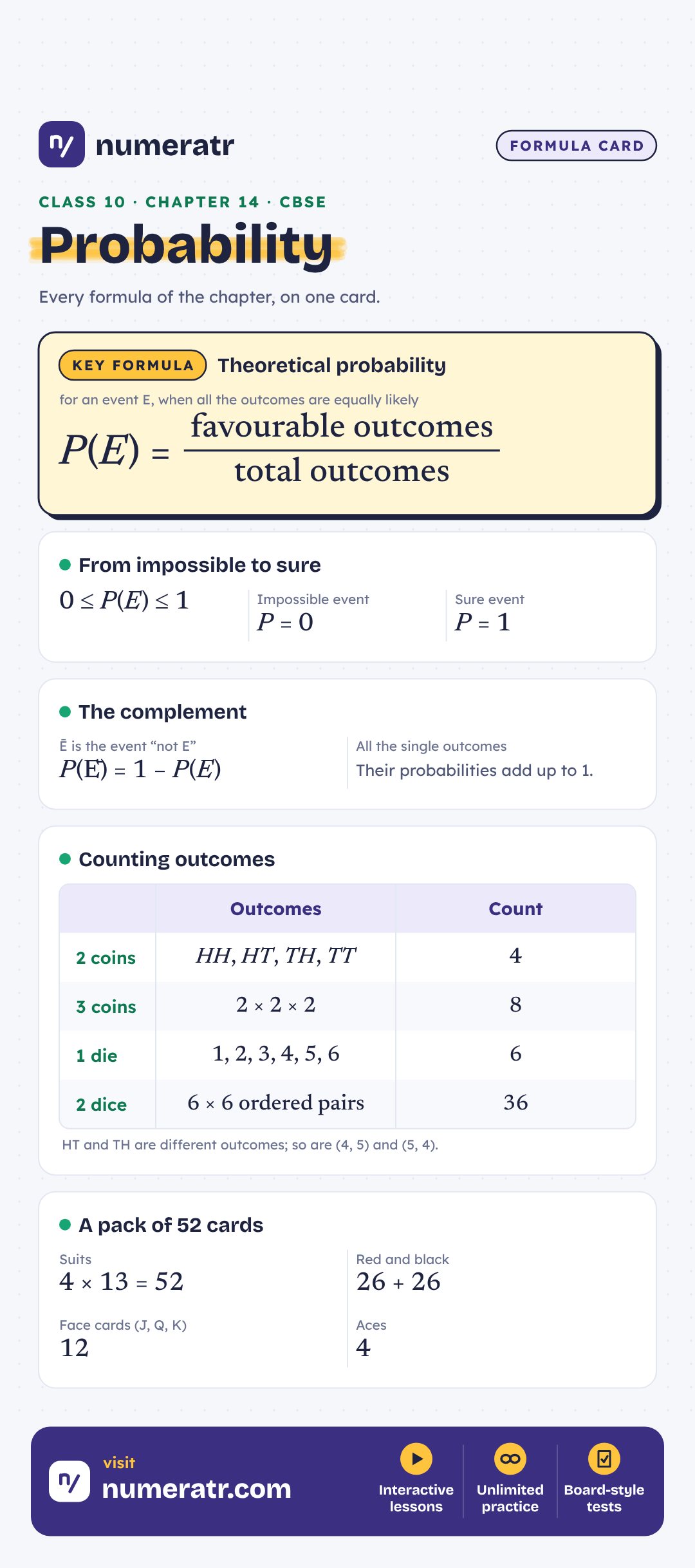
Free to share with friends and study groups.
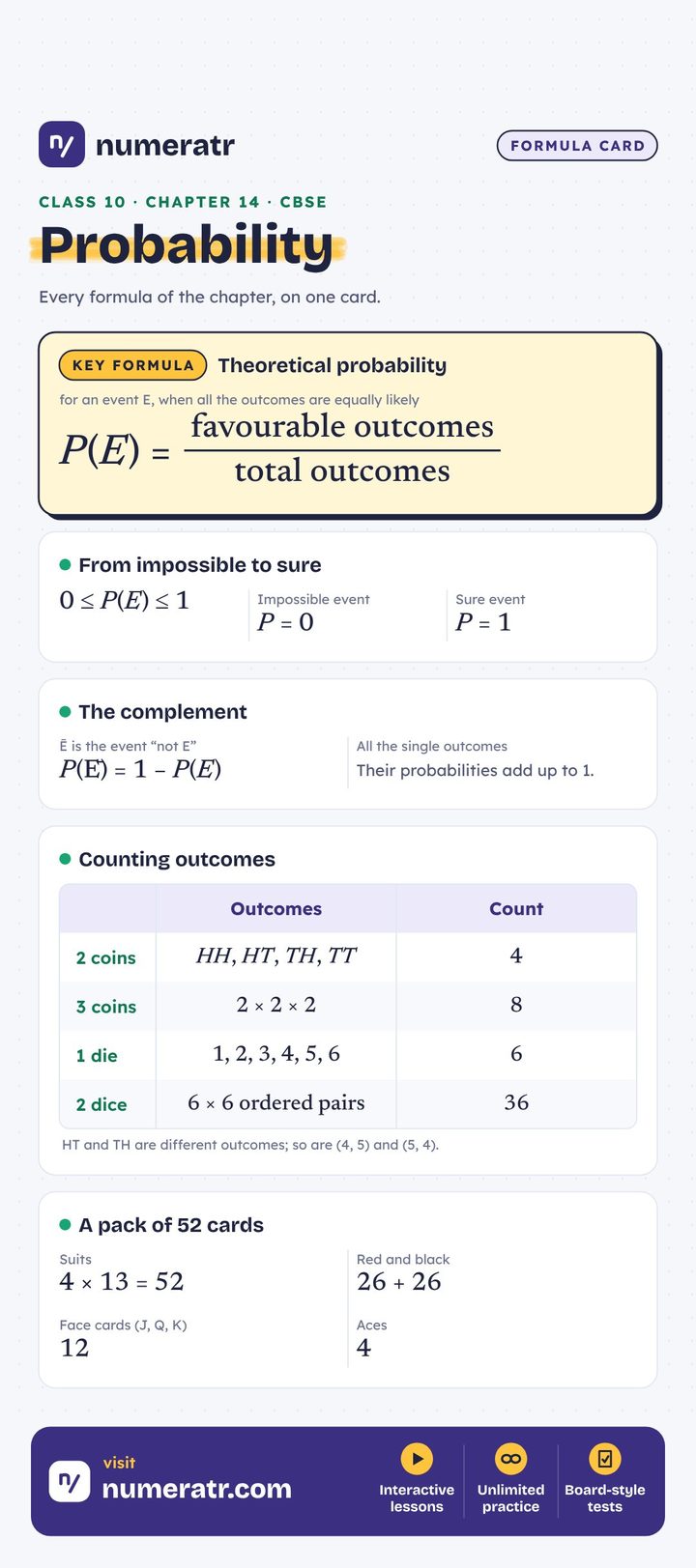
Learn, practise, test
Every chapter on Numeratr follows the same three steps.
- 1Learn
Short stories and animated pictures explain each idea. After every idea, your child tries a question.
- 2Practise
Practice that adapts from Easy to Challenge, by pattern, or ten at a time. Hints and a full solution for every question.
- 3Test
A board-style chapter test, sections A to E like the board paper. Fresh numbers every time.
Try three questions
From a starter to a challenge. Have a go before you open the answer.
A number is chosen at random from 1 to 80. Find the probability that it is a perfect square.
Show the answerHide the answer
1/10
- The perfect squares up to 80 are 1, 4, 9, 16, 25, 36, 49 and 64: there are 8.
- P = 8/80 = 1/10.
Two dice are thrown together. Find the probability that the difference of the numbers is 2.
Show the answerHide the answer
2/9
- Favourable outcomes: (1, 3), (2, 4), (3, 5), (4, 6) and the same four the other way round, 8 in all.
- P = 8/36 = 2/9.
Kavya throws a die twice. Find the probability that she gets a 5 or a 6 on at least one of the throws.
Show the answerHide the answer
5/9
- It is quicker to find the complement: no 5 or 6 on either throw.
- That happens in 4 × 4 = 16 of the 36 outcomes.
- P(at least once) = 1 − 16/36 = 20/36 = 5/9.
Learn Probability the right way
Interactive lessons, endless practice that adapts, and tests with a fresh paper every time. Children earn NerdCoins for real effort, and parents get a clear report.
One chapter in every class is free.