Chapter guides › Class 10 maths
CBSE Class 10 maths · Chapter 4
Quadratic Equations
Standard form, solving by factorisation and by the quadratic formula, the discriminant and the nature of roots, and word problems.
- NCERT Chapter 4
- 5 interactive lessons
- Endless practice
- Board-style test
About this chapter
Quadratic Equations is Chapter 4 of CBSE Class 10 maths. A quadratic equation has the form ax² + bx + c = 0 with a ≠ 0, and it turns up whenever an area, a speed or a thrown ball is involved.
The chapter gives two ways to solve one: by splitting the middle term, and by the quadratic formula, which works every time. The number b² − 4ac inside the formula, the discriminant, tells you before solving whether the roots are two, one repeated, or not real at all. Board papers test all three, together with word problems.
Key results and formulas
- Standard form
- ax² + bx + c = 0, where a ≠ 0
- Quadratic formula
- x = (−b ± √(b² − 4ac)) ÷ 2a
- Discriminant
- D = b² − 4ac
- Nature of the roots
- D > 0: two different real roots. D = 0: two equal real roots, x = −b/2a. D < 0: no real roots.
- Splitting the middle term
- Find two numbers with product ac and sum b.
- Roots and coefficients
- Sum of the roots = −b/a; product = c/a.
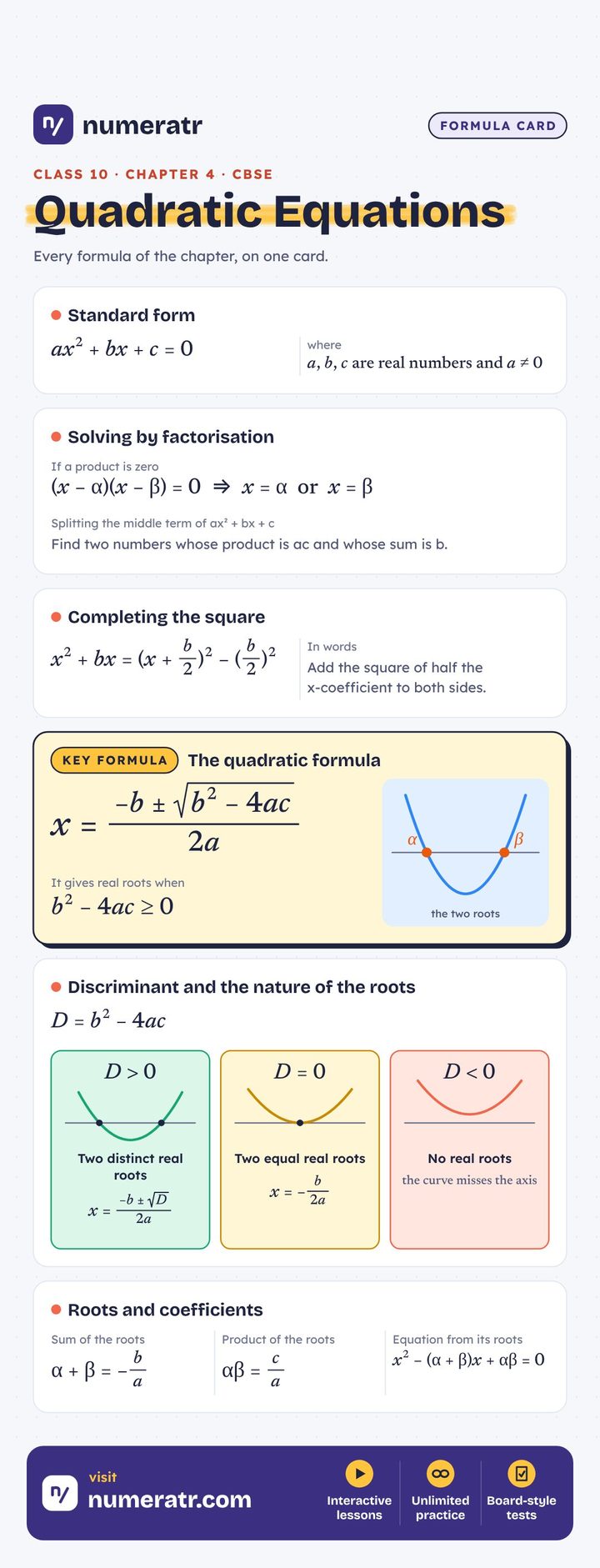
Every formula of Quadratic Equations on one card
A free revision card, made to be saved and shared. It covers:
- Standard form
- Quadratic formula
- Discriminant
- Nature of the roots
- Splitting the middle term
- Roots and coefficients
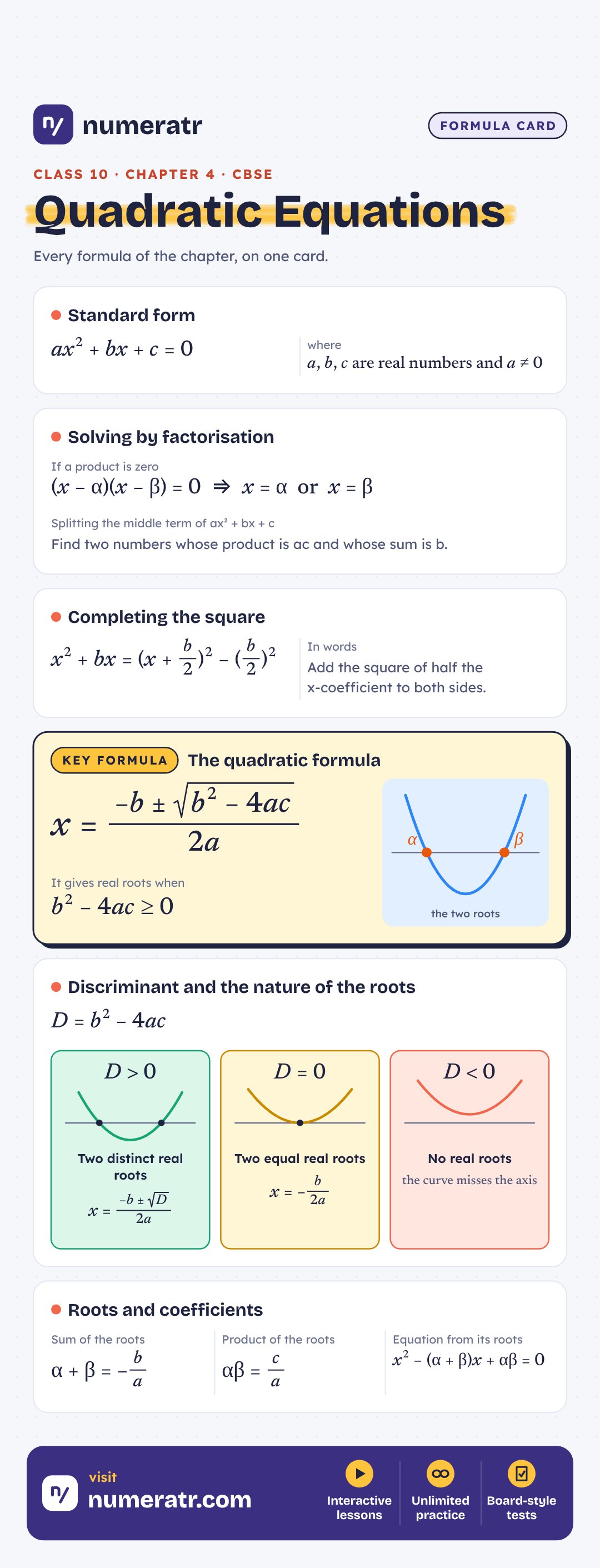
Free to share with friends and study groups.
Learn, practise, test
Every chapter on Numeratr follows the same three steps.
- 1Learn
Short stories and animated pictures explain each idea. After every idea, your child tries a question.
- 2Practise
Practice that adapts from Easy to Challenge, by pattern, or ten at a time. Hints and a full solution for every question.
- 3Test
A board-style chapter test, sections A to E like the board paper. Fresh numbers every time.
Try three questions
From a starter to a challenge. Have a go before you open the answer.
The length of a rectangle is 3 m more than its breadth, and its area is 40 m². Find its breadth.
Show the answerHide the answer
5 m
- x(x + 3) = 40 gives x² + 3x − 40 = 0.
- (x + 8)(x − 5) = 0, so x = −8 or x = 5.
- A breadth cannot be negative, so the breadth is 5 m.
Find the greatest value of k for which x² + 4x + k = 0 has real roots.
Show the answerHide the answer
4
- Real roots need D = 16 − 4k ≥ 0.
- So 4k ≤ 16, that is k ≤ 4.
- The greatest value is k = 4.
A rectangle has an area of 64 m². What is the least perimeter it can have?
Show the answerHide the answer
32 m
- If the perimeter is P, the sides are the roots of x² − (P/2)x + 64 = 0.
- Real sides need P²/4 − 256 ≥ 0, so P ≥ 32.
- At P = 32, D = 0: a square of side 8 m. The least perimeter is 32 m.
Learn Quadratic Equations the right way
Interactive lessons, endless practice that adapts, and tests with a fresh paper every time. Children earn NerdCoins for real effort, and parents get a clear report.
One chapter in every class is free.