Chapter guides › Class 10 maths
CBSE Class 10 maths · Chapter 1
Real Numbers
Prime factorisation, HCF and LCM, and proofs that numbers like √2 are irrational: what the chapter covers, the key results, worked examples and how Numeratr teaches it.
- NCERT Chapter 1
- 3 interactive lessons
- Endless practice
- Board-style test
About this chapter
Real Numbers is the first chapter of CBSE Class 10 maths. It rests on one big idea: every whole number greater than 1 is built from primes in exactly one way. This is the Fundamental Theorem of Arithmetic.
From that single idea come the three things the chapter asks of you: finding the HCF and LCM of numbers from their prime factors, deciding when a number like 6ⁿ can end in 0, and proving that numbers such as √2, √5 and 3 + 2√5 are irrational. Board papers test all three, from short HCF–LCM word problems to a full proof by contradiction.
Key results and formulas
- Fundamental Theorem of Arithmetic
- Every composite number can be written as a product of primes in exactly one way, apart from the order.
- HCF from prime factors
- Multiply the smallest power of each prime common to the numbers.
- LCM from prime factors
- Multiply the greatest power of every prime that appears.
- HCF and LCM of two numbers
- HCF(a, b) × LCM(a, b) = a × b (true for two numbers, not for three).
- Ending in 0
- A number ends in 0 only if its prime factors include both 2 and 5.
- The key step in irrationality proofs
- If a prime p divides a², then p divides a.
- Rational and irrational
- rational + irrational = irrational; a non-zero rational × an irrational = irrational.
Every formula of Real Numbers on one card
A free revision card, made to be saved and shared. It covers:
- Fundamental Theorem of Arithmetic
- HCF from prime factors
- LCM from prime factors
- HCF and LCM of two numbers
- Ending in 0
- The key step in irrationality proofs
- Rational and irrational
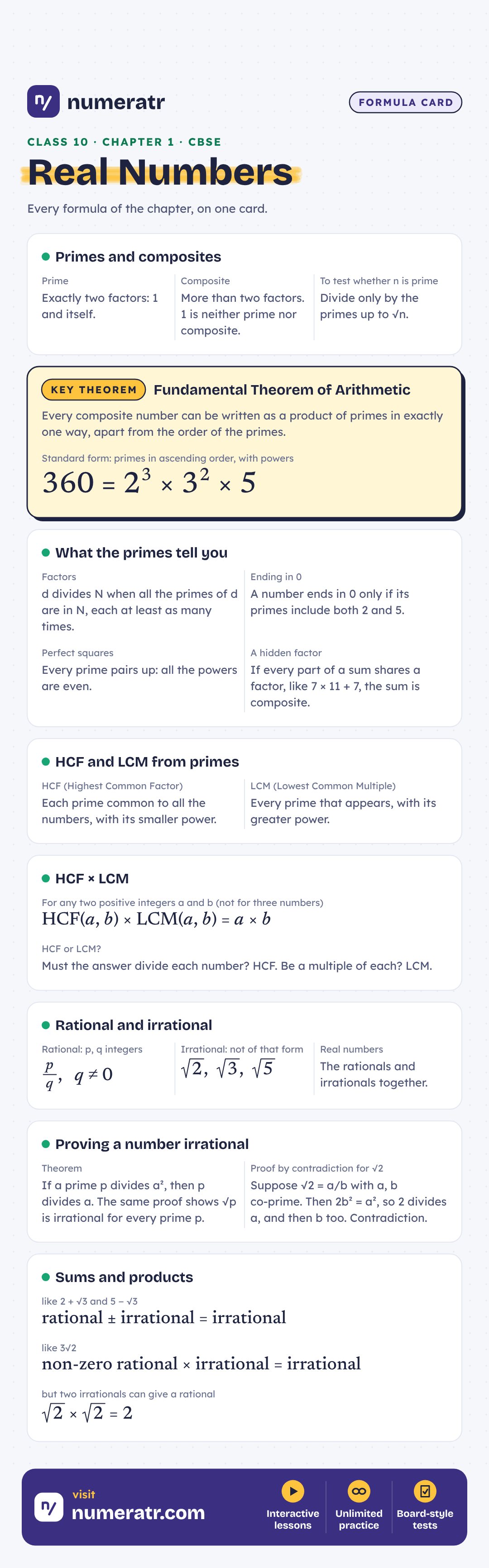
Free to share with friends and study groups.
Learn, practise, test
Every chapter on Numeratr follows the same three steps.
- 1Learn
Short stories and animated pictures explain each idea. After every idea, your child tries a question.
- 2Practise
Practice that adapts from Easy to Challenge, by pattern, or ten at a time. Hints and a full solution for every question.
- 3Test
A board-style chapter test, sections A to E like the board paper. Fresh numbers every time.
Try three questions
From a starter to a challenge. Have a go before you open the answer.
Find the LCM of 20, 28 and 42.
Show the answerHide the answer
420
- 20 = 2² × 5, 28 = 2² × 7 and 42 = 2 × 3 × 7.
- The primes are 2, 3, 5 and 7, with greatest powers 2², 3, 5 and 7.
- LCM = 2² × 3 × 5 × 7 = 420.
Meera, Arjun and Kavya walk side by side. Their steps measure 32 cm, 36 cm and 40 cm. What is the minimum distance each should walk so that all of them cover it in complete steps?
Show the answerHide the answer
1440 cm (14.4 m)
- 32 = 2⁵, 36 = 2² × 3² and 40 = 2³ × 5.
- LCM = 2⁵ × 3² × 5 = 1440, so the minimum distance is 1440 cm, that is 14.4 m.
- Check: 1440 = 45 × 32 = 40 × 36 = 36 × 40.
Aditi multiplies all the natural numbers from 1 to 30. With how many zeros does the product end?
Show the answerHide the answer
7
- A zero at the end comes from a factor 10 = 2 × 5. There are far more 2s than 5s, so count the 5s.
- The multiples of 5 up to 30 are 5, 10, 15, 20, 25 and 30: six numbers.
- But 25 = 5² gives two 5s, so there are 6 + 1 = 7 fives, and the product ends in 7 zeros.
Learn Real Numbers the right way
Interactive lessons, endless practice that adapts, and tests with a fresh paper every time. Children earn NerdCoins for real effort, and parents get a clear report.
One chapter in every class is free.