Chapter guides › Class 10 maths
CBSE Class 10 maths · Chapter 9
Some Applications of Trigonometry
Heights and distances: angles of elevation and depression, and problems with one or two right triangles.
- NCERT Chapter 9
- 2 interactive lessons
- Endless practice
- Board-style test
About this chapter
Some Applications of Trigonometry is Chapter 9 of CBSE Class 10 maths. It uses the ratios from Chapter 8 to find heights and distances you cannot measure directly: towers, lighthouses, kites and trees.
Every problem comes down to a right triangle and one angle, the angle of elevation (looking up) or of depression (looking down). Harder problems need two triangles that share a side. Board papers usually set one long question from this chapter.
Key results and formulas
- Angle of elevation
- The angle above the horizontal at which you look up at an object.
- Angle of depression
- The angle below the horizontal at which you look down. It equals the angle of elevation from the other end.
- Choosing the ratio
- Height and distance along the ground: use tan. A slanting length such as a kite string: use sin or cos.
- Values used most
- tan 30° = 1/√3, tan 45° = 1, tan 60° = √3; √3 ≈ 1.732
Every formula of Some Applications of Trigonometry on one card
A free revision card, made to be saved and shared. It covers:
- Angle of elevation
- Angle of depression
- Choosing the ratio
- Values used most
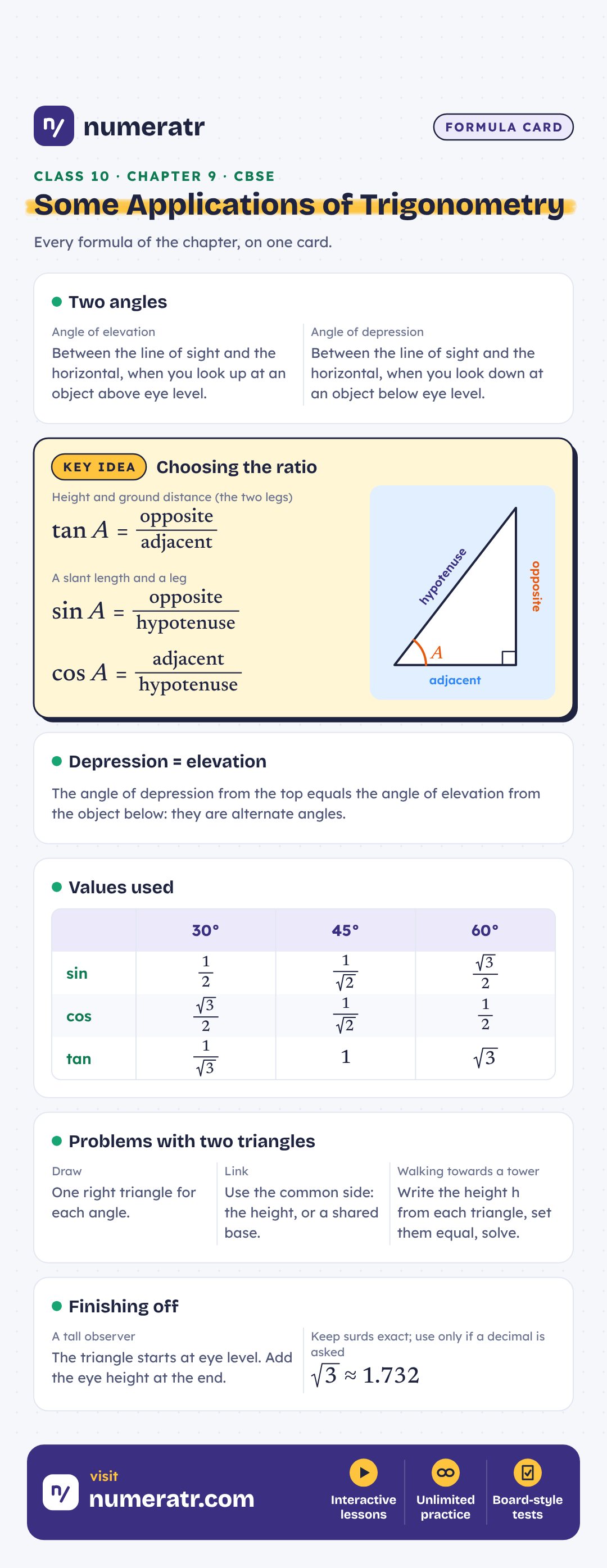
Free to share with friends and study groups.
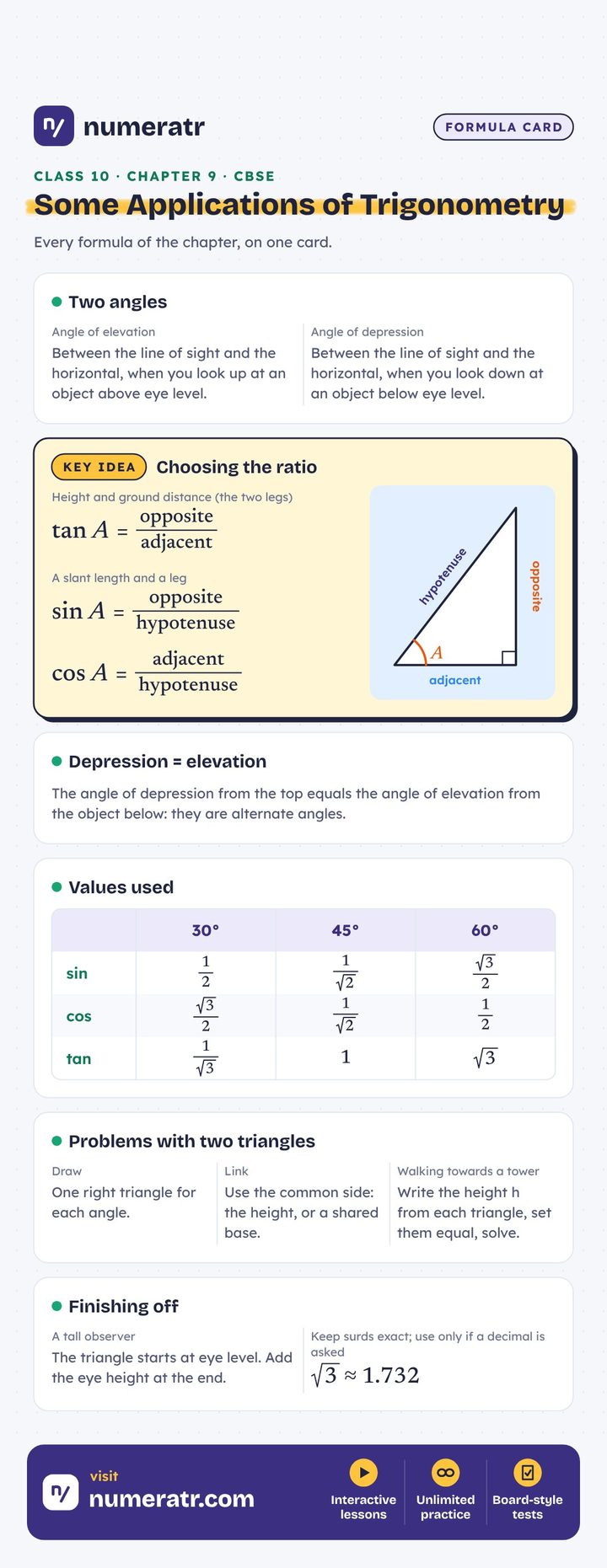
Learn, practise, test
Every chapter on Numeratr follows the same three steps.
- 1Learn
Short stories and animated pictures explain each idea. After every idea, your child tries a question.
- 2Practise
Practice that adapts from Easy to Challenge, by pattern, or ten at a time. Hints and a full solution for every question.
- 3Test
A board-style chapter test, sections A to E like the board paper. Fresh numbers every time.
Try three questions
From a starter to a challenge. Have a go before you open the answer.
A kite is flying on a straight string 50 m long, which makes an angle of 30° with the ground. Find the height of the kite.
Show the answerHide the answer
25 m
- The string is the hypotenuse, so height = 50 × sin 30°.
- 50 × 1/2 = 25 m.
From the top of a building 60 m high, the angles of depression of the top and the bottom of a tower are 30° and 60°. Find the height of the tower.
Show the answerHide the answer
40 m
- The distance between them is 60 ÷ tan 60° = 60/√3 = 20√3 m.
- The building is higher than the tower by 20√3 × tan 30° = 20 m.
- The tower is 60 − 20 = 40 m high.
A water tower 48 m high stands across a road from a house. From a window, the angle of elevation of the top of the tower is 60° and the angle of depression of its foot is 30°. How high is the window?
Show the answerHide the answer
12 m
- Let the window be w m high. The road is w ÷ tan 30° = w√3 m wide.
- The part of the tower above the window is w√3 × tan 60° = 3w.
- w + 3w = 48, so the window is 12 m above the ground.
Learn Some Applications of Trigonometry the right way
Interactive lessons, endless practice that adapts, and tests with a fresh paper every time. Children earn NerdCoins for real effort, and parents get a clear report.
One chapter in every class is free.