Chapter guides › Class 10 maths
CBSE Class 10 maths · Chapter 6
Triangles
Similar figures, the Basic Proportionality Theorem and its converse, and the AA, SSS and SAS tests for similar triangles.
- NCERT Chapter 6
- 3 interactive lessons
- Endless practice
- Board-style test
About this chapter
Triangles is Chapter 6 of CBSE Class 10 maths. It is about similar figures: same shape, any size, like a photo and its enlargement.
Its central result is the Basic Proportionality Theorem (also called Thales’ theorem): a line parallel to one side of a triangle cuts the other two sides in the same ratio. The chapter proves it, then gives three quick tests for similar triangles (AA, SSS and SAS), and uses them to find missing sides, heights from shadows, and more.
Key results and formulas
- Similar triangles
- Corresponding angles are equal and corresponding sides are in the same ratio.
- Basic Proportionality Theorem
- If DE ∥ BC in triangle ABC, then AD/DB = AE/EC.
- Converse of the BPT
- If AD/DB = AE/EC, then DE ∥ BC.
- AA criterion
- Two pairs of equal angles are enough for similarity.
- SSS criterion
- All three pairs of sides in the same ratio.
- SAS criterion
- One equal angle, and the sides that include it in the same ratio.
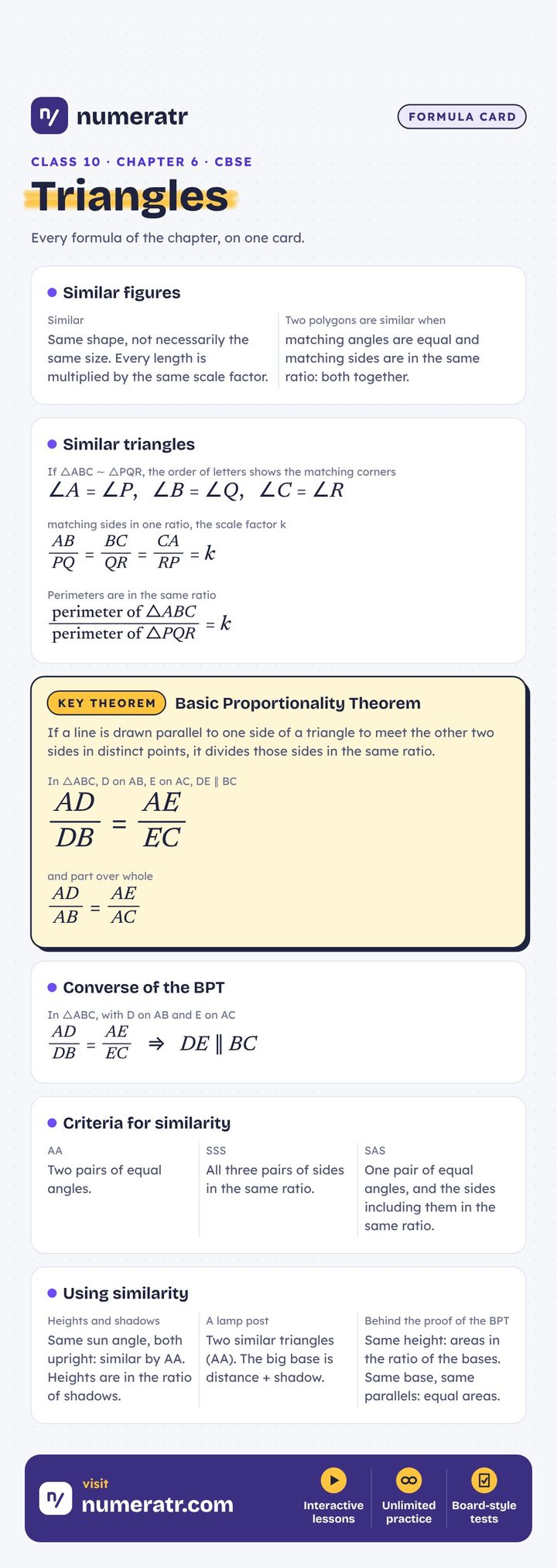
Every formula of Triangles on one card
A free revision card, made to be saved and shared. It covers:
- Similar triangles
- Basic Proportionality Theorem
- Converse of the BPT
- AA criterion
- SSS criterion
- SAS criterion
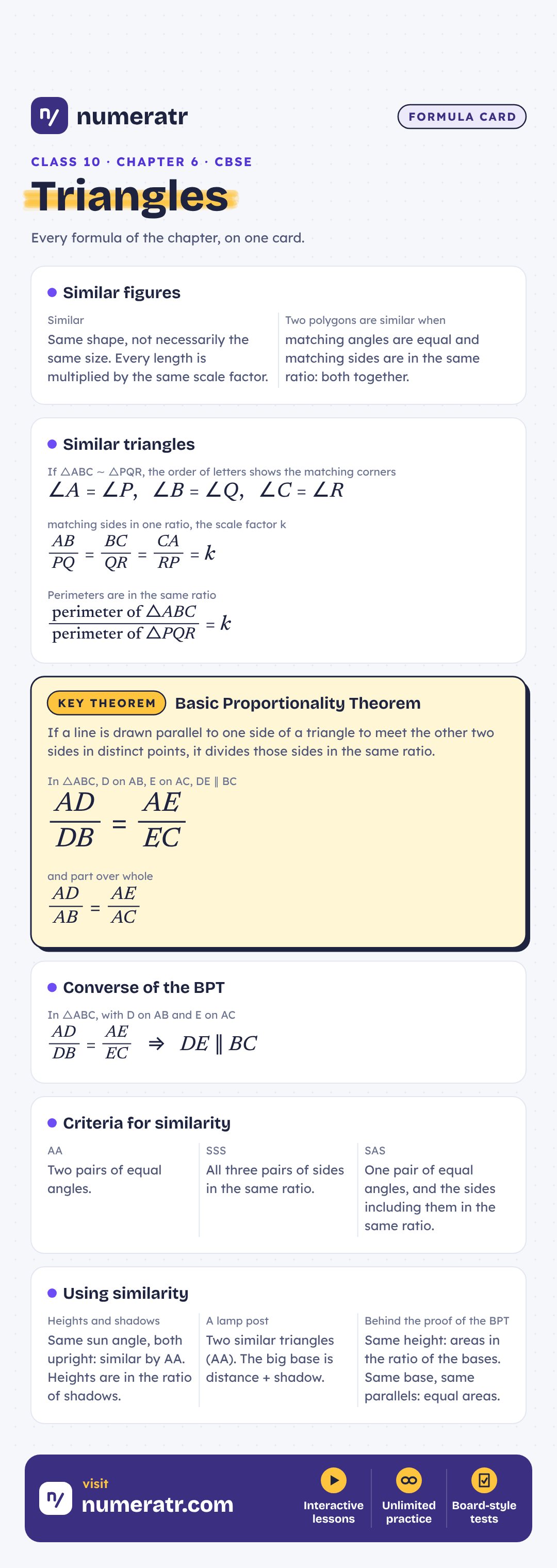
Free to share with friends and study groups.
Learn, practise, test
Every chapter on Numeratr follows the same three steps.
- 1Learn
Short stories and animated pictures explain each idea. After every idea, your child tries a question.
- 2Practise
Practice that adapts from Easy to Challenge, by pattern, or ten at a time. Hints and a full solution for every question.
- 3Test
A board-style chapter test, sections A to E like the board paper. Fresh numbers every time.
Try three questions
From a starter to a challenge. Have a go before you open the answer.
In triangle ABC, DE ∥ BC with D on AB and E on AC. AD = 2 cm, DB = 3 cm and AE = 4 cm. Find EC.
Show the answerHide the answer
6 cm
- By the Basic Proportionality Theorem, AD/DB = AE/EC.
- 2/3 = 4/EC, so EC = 4 × 3 ÷ 2.
- EC = 6 cm.
In triangle ABC, AB = 8 cm and AC = 6 cm. D is on AB with AD = 4 cm, and E is on AC with AE = 3 cm. If DE = 2.5 cm, find BC.
Show the answerHide the answer
5 cm
- AD/AB = 4/8 = 1/2 and AE/AC = 3/6 = 1/2, and angle A is common.
- So triangle ADE ∼ triangle ABC by SAS.
- DE/BC = 1/2, so BC = 5 cm.
In triangle LMN, K is a point on MN such that ∠MLK = ∠MNL. If MN = 16 cm and MK = 9 cm, find LM.
Show the answerHide the answer
12 cm
- ∠MLK = ∠MNL and ∠M is common, so triangle MLK ∼ triangle MNL (AA).
- ML/MN = MK/ML, so LM² = 16 × 9 = 144.
- LM = 12 cm.
Learn Triangles the right way
Interactive lessons, endless practice that adapts, and tests with a fresh paper every time. Children earn NerdCoins for real effort, and parents get a clear report.
One chapter in every class is free.