Chapter guides › Class 8 maths
CBSE Class 8 maths · Chapter 9
The Baudhāyana–Pythagoras Theorem
Doubling a square and the square root of 2, the Baudhāyana–Pythagoras theorem and its proof, its converse, triples, and right triangles in everyday problems, for the new CBSE Class 8 book.
- Ganita Prakash Part II, Chapter 2
- 3 interactive lessons
- Endless practice
- exam-style test
About this chapter
The Baudhāyana–Pythagoras Theorem is the second chapter of Part II of the new NCERT book Ganita Prakash for CBSE Class 8. It begins with an old question: how do you draw a square with exactly double the area of a given square?
The answer leads to √2 and to the theorem itself: in a right triangle, the square on the hypotenuse equals the squares on the other two sides. The chapter proves it, uses it to find missing sides and test for right angles, and builds Baudhāyana triples such as 3, 4, 5 and 5, 12, 13.
Key results and formulas
- The theorem
- a² + b² = c², where c is the hypotenuse
- Hypotenuse
- c = √(a² + b²)
- A shorter side
- b = √(c² − a²)
- Right-angle test
- If a² + b² = c², the triangle is right-angled.
- Isosceles right triangle
- h = a × √2, with √2 ≈ 1.414
- Triples
- 3, 4, 5; 5, 12, 13; 8, 15, 17
Every formula of The Baudhāyana–Pythagoras Theorem on one card
A free revision card, made to be saved and shared. It covers:
- The theorem
- Hypotenuse
- A shorter side
- Right-angle test
- Isosceles right triangle
- Triples
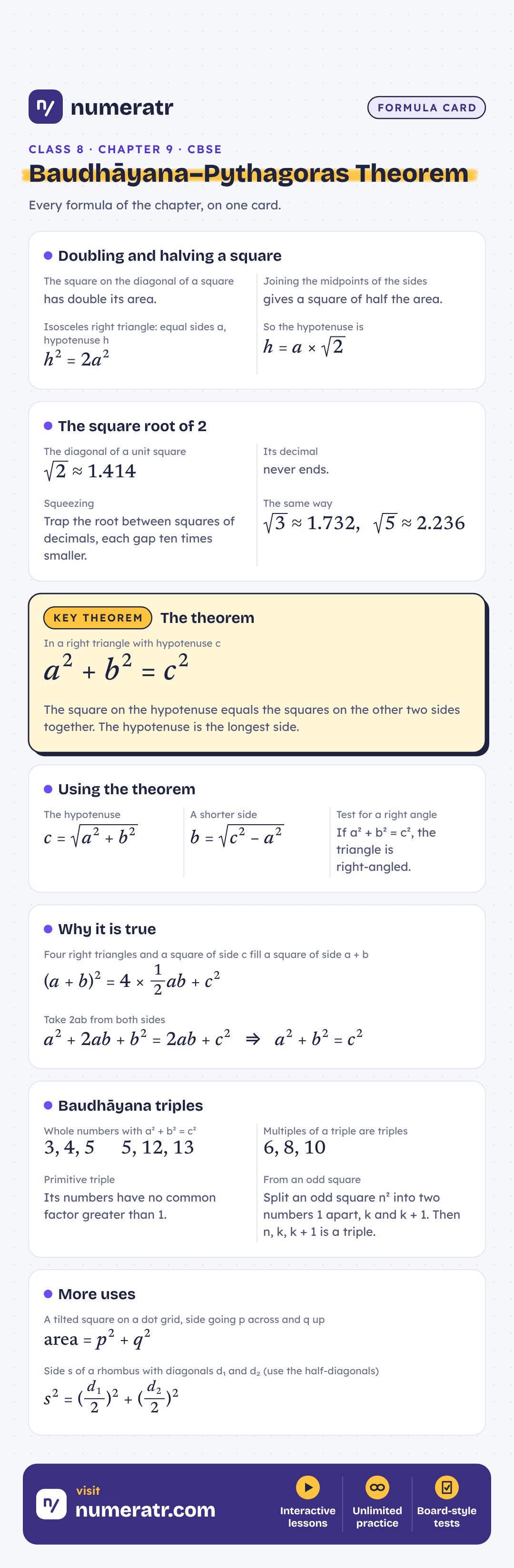
Free to share with friends and study groups.
Learn, practise, test
Every chapter on Numeratr follows the same three steps.
- 1Learn
Short stories and animated pictures explain each idea. After every idea, your child tries a question.
- 2Practise
Practice that adapts from Easy to Challenge, by pattern, or ten at a time. Hints and a full solution for every question.
- 3Test
An exam-style chapter test, sections A to E in the CBSE paper pattern. Fresh numbers every time.
Try three questions
From a starter to a challenge. Have a go before you open the answer.
The two shorter sides of a right triangle are 9 cm and 12 cm. Find the hypotenuse.
Show the answerHide the answer
15 cm
- c² = 9² + 12² = 81 + 144 = 225.
- c = √225 = 15 cm.
A 17 m ladder leans against a wall and reaches a window 15 m above the ground. How far is the foot of the ladder from the wall?
Show the answerHide the answer
8 m
- The ladder is the hypotenuse: 17² = 15² + d².
- d² = 289 − 225 = 64, so d = 8 m.
The diagonals of a rhombus are 30 cm and 16 cm long. Find its perimeter.
Show the answerHide the answer
68 cm
- The diagonals bisect each other at right angles, making right triangles with legs 15 cm and 8 cm.
- Side² = 15² + 8² = 225 + 64 = 289, so each side is 17 cm.
- Perimeter = 4 × 17 = 68 cm.
Learn The Baudhāyana–Pythagoras Theorem the right way
Interactive lessons, endless practice that adapts, and tests with a fresh paper every time. Children earn NerdCoins for real effort, and parents get a clear report.
One chapter in every class is free.