Chapter guides › Class 8 maths
CBSE Class 8 maths · Chapter 5
Divisibility and Number Patterns
Sums of consecutive numbers, odd and even, remainders, divisibility tests, digital roots and cryptarithms, for the new CBSE Class 8 book.
- Ganita Prakash Part I, Chapter 5
- 5 interactive lessons
- Endless practice
- exam-style test
About this chapter
Divisibility and Number Patterns is Chapter 5 of CBSE Class 8 maths, called ‘Number Play’ in the new NCERT book Ganita Prakash. It asks which numbers can be written as sums of consecutive numbers, and uses odd and even to settle puzzles quickly.
The chapter goes on to remainders, the divisibility tests for 2 to 11 and how to combine them, digital roots for checking calculations, and cryptarithms, where each letter hides a digit.
Key results and formulas
- Three consecutive numbers
- (n − 1) + n + (n + 1) = 3n
- Odd and even
- even + even = even, odd + odd = even, even + odd = odd
- Remainder on division by d
- A number with remainder r is dk + r.
- Tests for 3 and 9
- The digit sum is divisible by 3 (or by 9).
- Tests for 4 and 8
- The last two digits divisible by 4; the last three by 8.
- Test for 11
- Add and subtract the digits in turn from the right; the result is 0 or a multiple of 11.
- Combining tests
- 2 and 3 give 6; 3 and 4 give 12. Only for numbers with no common factor.
Every formula of Divisibility and Number Patterns on one card
A free revision card, made to be saved and shared. It covers:
- Three consecutive numbers
- Odd and even
- Remainder on division by d
- Tests for 3 and 9
- Tests for 4 and 8
- Test for 11
- Combining tests
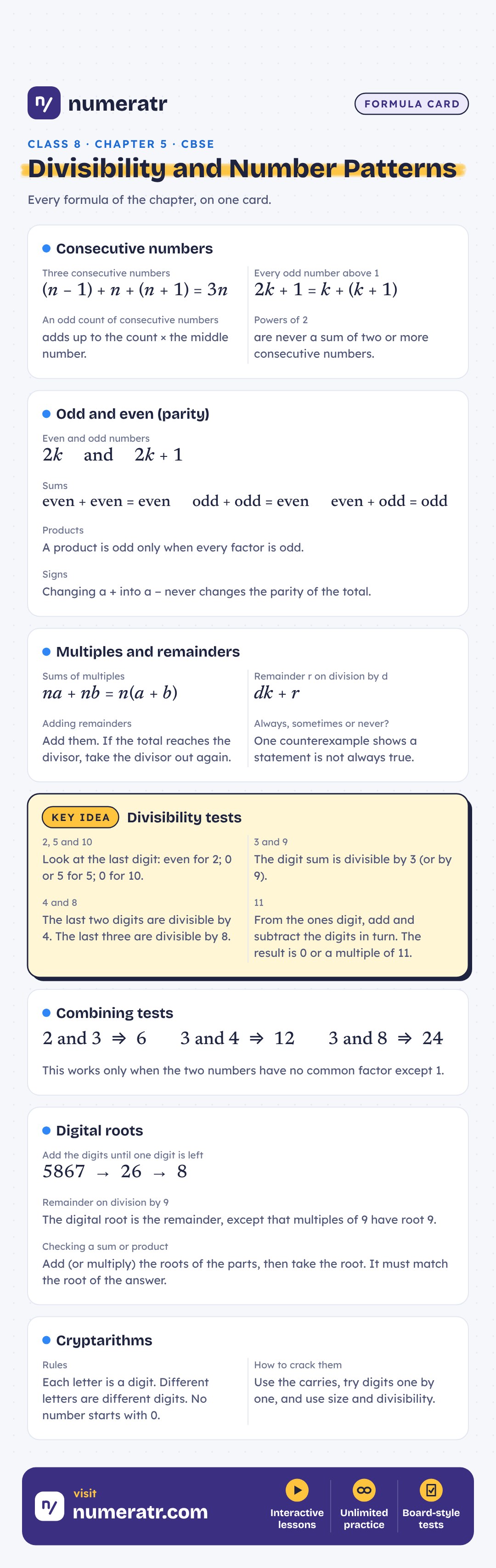
Free to share with friends and study groups.
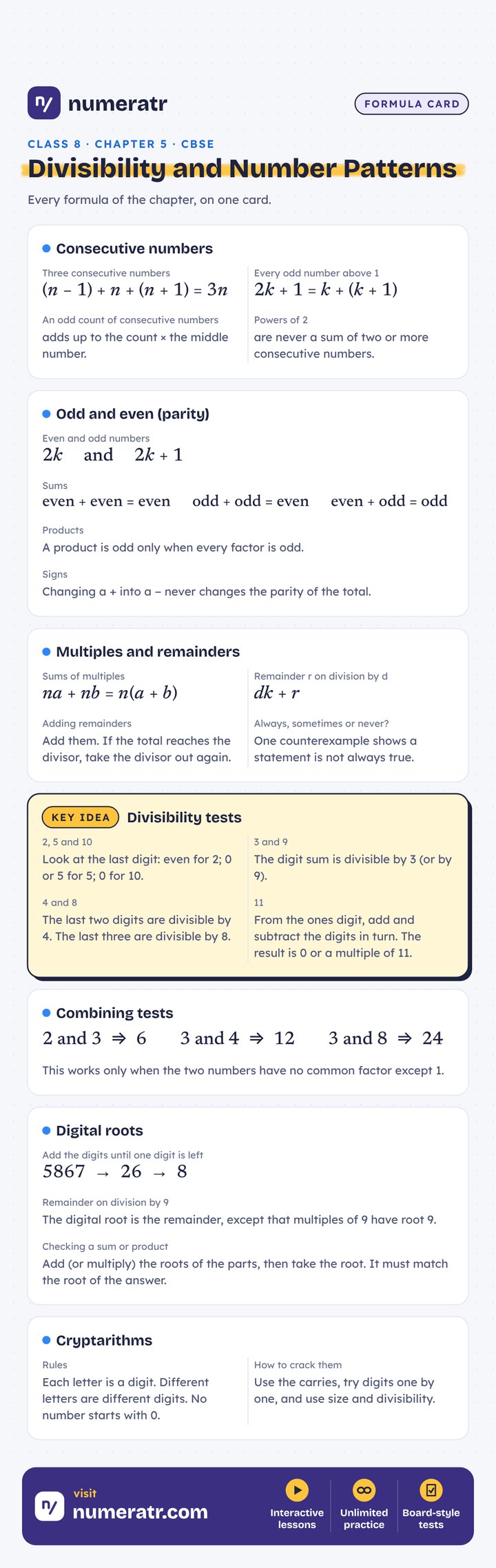
Learn, practise, test
Every chapter on Numeratr follows the same three steps.
- 1Learn
Short stories and animated pictures explain each idea. After every idea, your child tries a question.
- 2Practise
Practice that adapts from Easy to Challenge, by pattern, or ten at a time. Hints and a full solution for every question.
- 3Test
An exam-style chapter test, sections A to E in the CBSE paper pattern. Fresh numbers every time.
Try three questions
From a starter to a challenge. Have a go before you open the answer.
Is 4,08,372 divisible by 4? Is it divisible by 9?
Show the answerHide the answer
Divisible by 4, not by 9
- The last two digits, 72, are divisible by 4, so the number is.
- The digit sum is 4 + 0 + 8 + 3 + 7 + 2 = 24, which is not a multiple of 9, so it is not divisible by 9.
Find the digit A if the number 5A62 is divisible by 9.
Show the answerHide the answer
A = 5
- The digit sum is 5 + A + 6 + 2 = 13 + A.
- It must be a multiple of 9, and A is a single digit, so 13 + A = 18 and A = 5.
- Check: 5562 ÷ 9 = 618.
Can 64 be written as a sum of two or more consecutive whole numbers? What about 63?
Show the answerHide the answer
64 cannot; 63 can, for example 20 + 21 + 22
- 64 = 2⁶ is a power of 2, and powers of 2 are never a sum of two or more consecutive numbers.
- 63 = 3 × 21, so three consecutive numbers with middle 21 work: 20 + 21 + 22 = 63.
Learn Divisibility and Number Patterns the right way
Interactive lessons, endless practice that adapts, and tests with a fresh paper every time. Children earn NerdCoins for real effort, and parents get a clear report.
One chapter in every class is free.