Chapter guides › Class 8 maths
CBSE Class 8 maths · Chapter 3
Numerals and Place Value
How people counted before numerals, Egyptian and Roman numerals, Babylonian and Mayan place value, why zero matters, and numbers in other bases, for the new CBSE Class 8 book.
- Ganita Prakash Part I, Chapter 3
- 3 interactive lessons
- Endless practice
- exam-style test
About this chapter
Numerals and Place Value is Chapter 3 of CBSE Class 8 maths, called ‘A Story of Numbers’ in the new NCERT book Ganita Prakash. It traces how people counted: matching marks to things, counting on fingers, then grouping into landmark numbers.
The chapter compares Egyptian and Roman numerals with the place-value systems of the Babylonians (base 60) and the Mayans (base 20), shows why a symbol for zero made the Indian system work, and ends with writing numbers in other bases, including binary.
Key results and formulas
- Roman numerals
- I = 1, V = 5, X = 10, L = 50, C = 100, D = 500, M = 1000
- Roman subtraction
- A smaller letter before a larger one is taken away: IV = 4, XC = 90, CM = 900.
- Place value in base 10
- 4404 = 4 × 1000 + 4 × 100 + 0 × 10 + 4
- Babylonian (base 60)
- (2)(10) = 2 × 60 + 10 = 130
- Landmarks in base b
- 1, b, b², b³, … with digits 0 to b − 1
- Base 5 to base 10
- (231)₅ = 2 × 25 + 3 × 5 + 1 = 66
- Binary
- (1011)₂ = 8 + 2 + 1 = 11
Every formula of Numerals and Place Value on one card
A free revision card, made to be saved and shared. It covers:
- Roman numerals
- Roman subtraction
- Place value in base 10
- Babylonian (base 60)
- Landmarks in base b
- Base 5 to base 10
- Binary
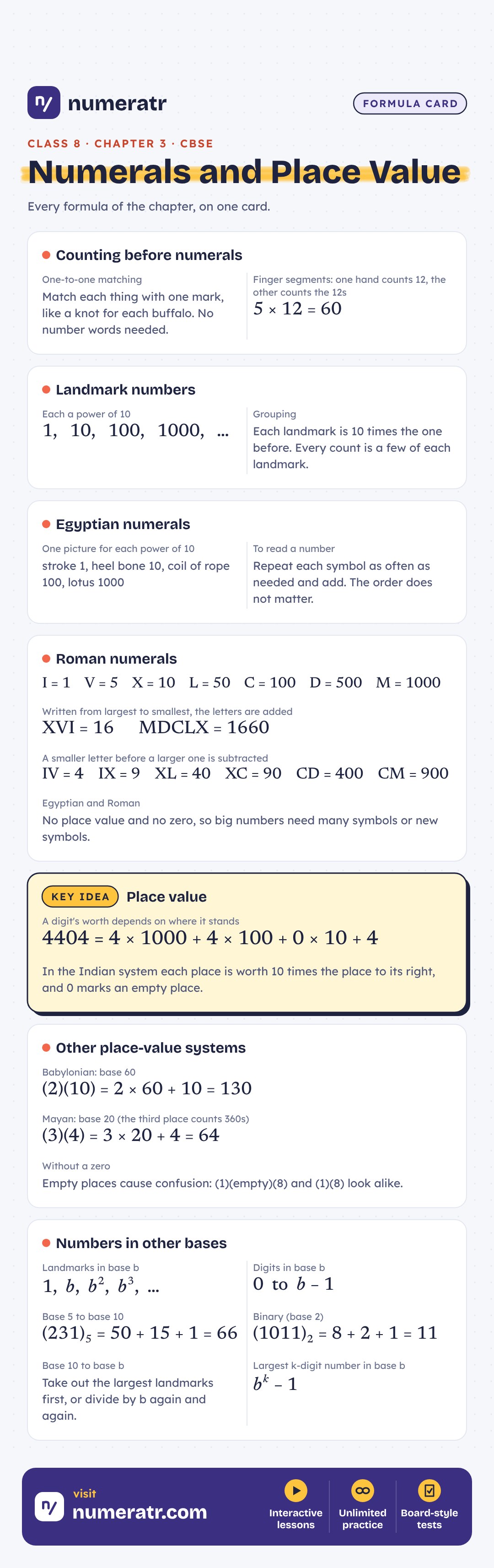
Free to share with friends and study groups.
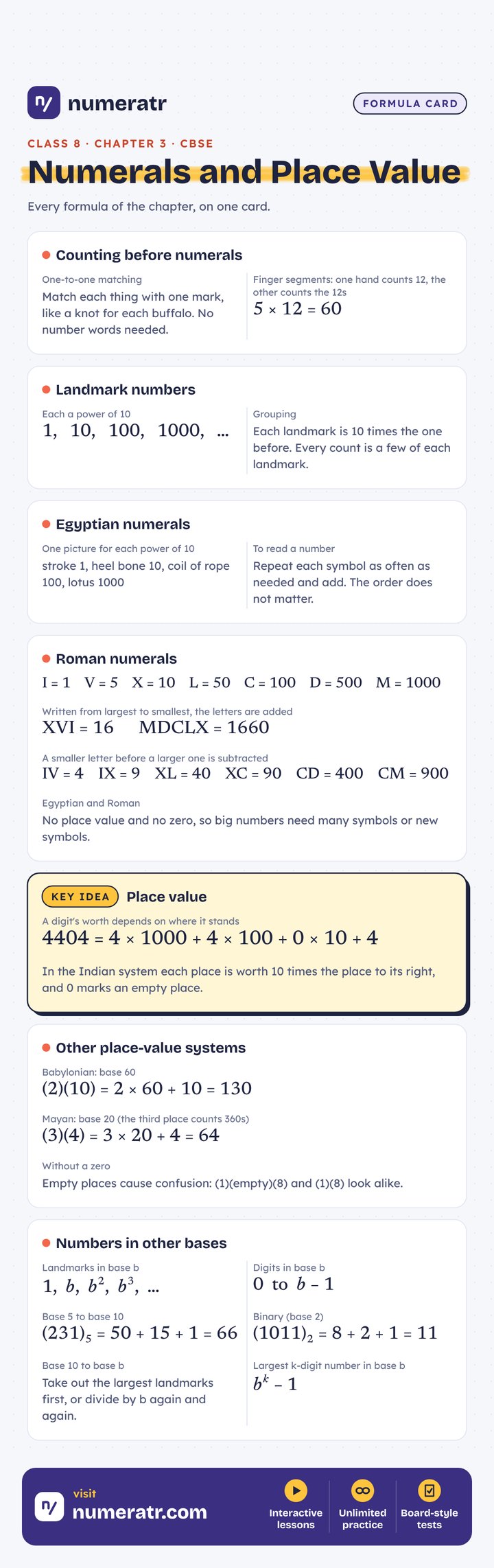
Learn, practise, test
Every chapter on Numeratr follows the same three steps.
- 1Learn
Short stories and animated pictures explain each idea. After every idea, your child tries a question.
- 2Practise
Practice that adapts from Easy to Challenge, by pattern, or ten at a time. Hints and a full solution for every question.
- 3Test
An exam-style chapter test, sections A to E in the CBSE paper pattern. Fresh numbers every time.
Try three questions
From a starter to a challenge. Have a go before you open the answer.
Write 1,948 in Roman numerals.
Show the answerHide the answer
MCMXLVIII
- 1948 = 1000 + 900 + 40 + 8.
- 1000 = M, 900 = CM, 40 = XL and 8 = VIII.
- So 1948 = MCMXLVIII.
Convert (3021)₄ to base 10.
Show the answerHide the answer
201
- The places in base 4 are worth 64, 16, 4 and 1.
- 3 × 64 + 0 × 16 + 2 × 4 + 1 = 192 + 0 + 8 + 1 = 201.
In which base b is (24)₍b₎ equal to 22?
Show the answerHide the answer
Base 9
- (24) in base b means 2 × b + 4.
- 2b + 4 = 22 gives b = 9.
- Check: in base 9, 24 = 2 × 9 + 4 = 22, and 4 is a valid digit.
Learn Numerals and Place Value the right way
Interactive lessons, endless practice that adapts, and tests with a fresh paper every time. Children earn NerdCoins for real effort, and parents get a clear report.
One chapter in every class is free.