Chapter guides › Class 8 maths
CBSE Class 8 maths · Chapter 8
Percentages and Their Applications
Percentages, percentage increase and decrease, profit and loss, discounts and GST, and simple and compound interest, for the new CBSE Class 8 book.
- Ganita Prakash Part II, Chapter 1
- 5 interactive lessons
- Endless practice
- exam-style test
About this chapter
Percentages and Their Applications follows ‘Fractions in Disguise’, the first chapter of Part II of the new NCERT book Ganita Prakash for CBSE Class 8. A percentage is a fraction out of 100, which makes scores, prices and changes easy to compare.
The chapter covers percentage increase and decrease and working back to the original, successive changes, profit and loss, markup, discount and GST, and simple and compound interest, including why compound interest grows faster.
Key results and formulas
- x% of y
- (x ÷ 100) × y
- Percentage change
- change ÷ original × 100%
- Increase by r%
- original × (1 + r/100)
- Profit %
- profit ÷ cost price × 100
- Discount of d%
- SP = MP × (1 − d/100)
- Simple interest
- SI = P × R × T ÷ 100
- Compound interest
- A = P(1 + R/100)ᵀ
Every formula of Percentages and Their Applications on one card
A free revision card, made to be saved and shared. It covers:
- x% of y
- Percentage change
- Increase by r%
- Profit %
- Discount of d%
- Simple interest
- Compound interest
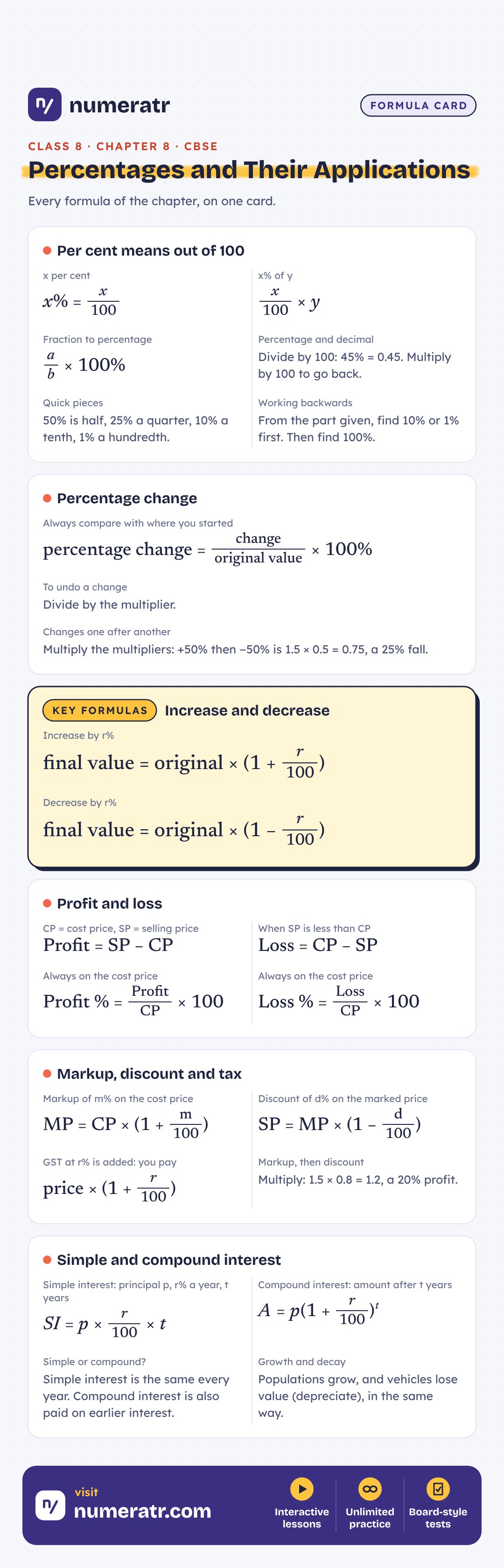
Free to share with friends and study groups.
Learn, practise, test
Every chapter on Numeratr follows the same three steps.
- 1Learn
Short stories and animated pictures explain each idea. After every idea, your child tries a question.
- 2Practise
Practice that adapts from Easy to Challenge, by pattern, or ten at a time. Hints and a full solution for every question.
- 3Test
An exam-style chapter test, sections A to E in the CBSE paper pattern. Fresh numbers every time.
Try three questions
From a starter to a challenge. Have a go before you open the answer.
What percentage of 75 is 18?
Show the answerHide the answer
24%
- 18 ÷ 75 × 100% = 1800 ÷ 75 %.
- = 24%.
Find the compound interest on ₹15,000 for 2 years at 10% a year.
Show the answerHide the answer
₹3,150
- A = 15000 × 1.1 × 1.1 = 15000 × 1.21 = ₹18,150.
- Compound interest = 18150 − 15000 = ₹3,150.
A shopkeeper marks a bag 40% above its cost price and then gives a 15% discount. What is the profit per cent?
Show the answerHide the answer
19% profit
- Take the cost price as ₹100. The marked price is ₹140.
- After a 15% discount the selling price is 140 × 0.85 = ₹119.
- Profit = ₹19 on ₹100, so 19%.
Learn Percentages and Their Applications the right way
Interactive lessons, endless practice that adapts, and tests with a fresh paper every time. Children earn NerdCoins for real effort, and parents get a clear report.
One chapter in every class is free.