Chapter guides › Class 8 maths
CBSE Class 8 maths · Chapter 4
Quadrilaterals
Rectangles and squares, the angle sum of a quadrilateral, parallelograms, rhombuses, kites and trapeziums, and how the whole family fits together, for the new CBSE Class 8 book.
- Ganita Prakash Part I, Chapter 4
- 4 interactive lessons
- Endless practice
- exam-style test
- Free chapter
About this chapter
Quadrilaterals is Chapter 4 of CBSE Class 8 maths in the new NCERT book Ganita Prakash. It starts with rectangles and squares and asks how you can be sure a corner is a right angle, using the diagonals.
The chapter proves that the angles of any quadrilateral add up to 360°, then studies parallelograms, rhombuses, kites and trapeziums: their sides, angles and diagonals, and how a square belongs to several families at once.
Key results and formulas
- Angle sum
- ∠A + ∠B + ∠C + ∠D = 360°
- Parallelogram
- Opposite sides equal and parallel; opposite angles equal; adjacent angles add up to 180°.
- Diagonals of a parallelogram
- They bisect each other.
- Rhombus
- Four equal sides; the diagonals bisect each other at right angles.
- Rectangle
- A parallelogram with equal diagonals.
- Kite
- Two pairs of equal adjacent sides; one diagonal is the perpendicular bisector of the other.
- Trapezium
- One pair of parallel sides; angles along a slanting side add up to 180°.
Every formula of Quadrilaterals on one card
A free revision card, made to be saved and shared. It covers:
- Angle sum
- Parallelogram
- Diagonals of a parallelogram
- Rhombus
- Rectangle
- Kite
- Trapezium
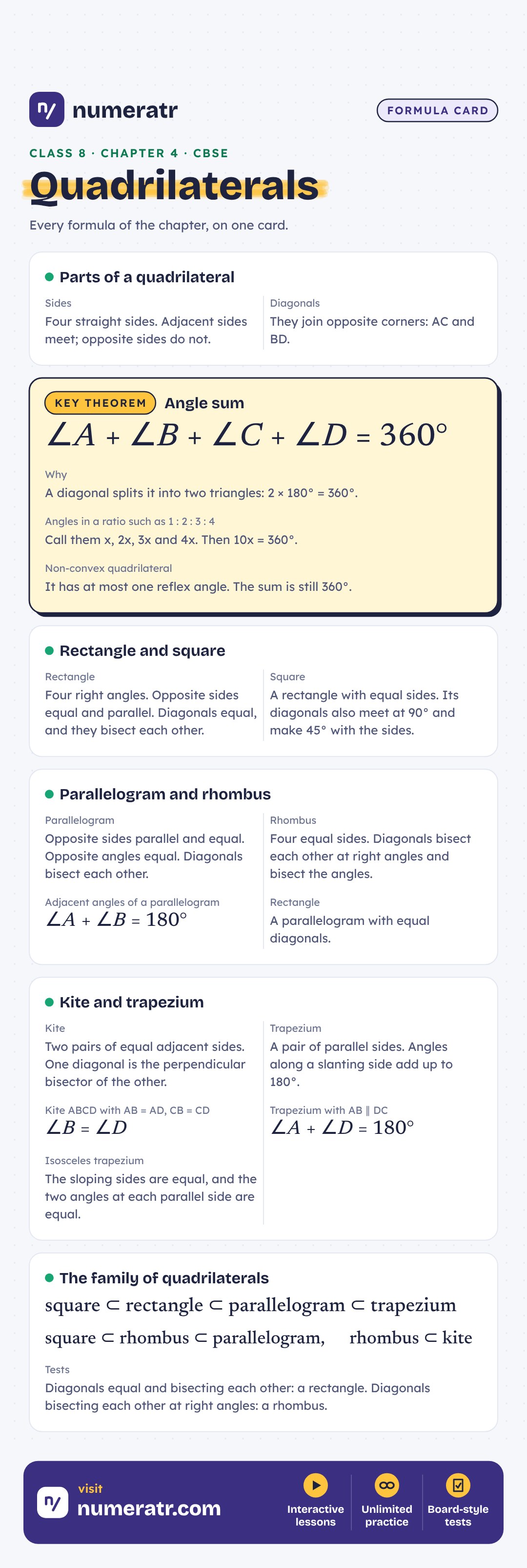
Free to share with friends and study groups.
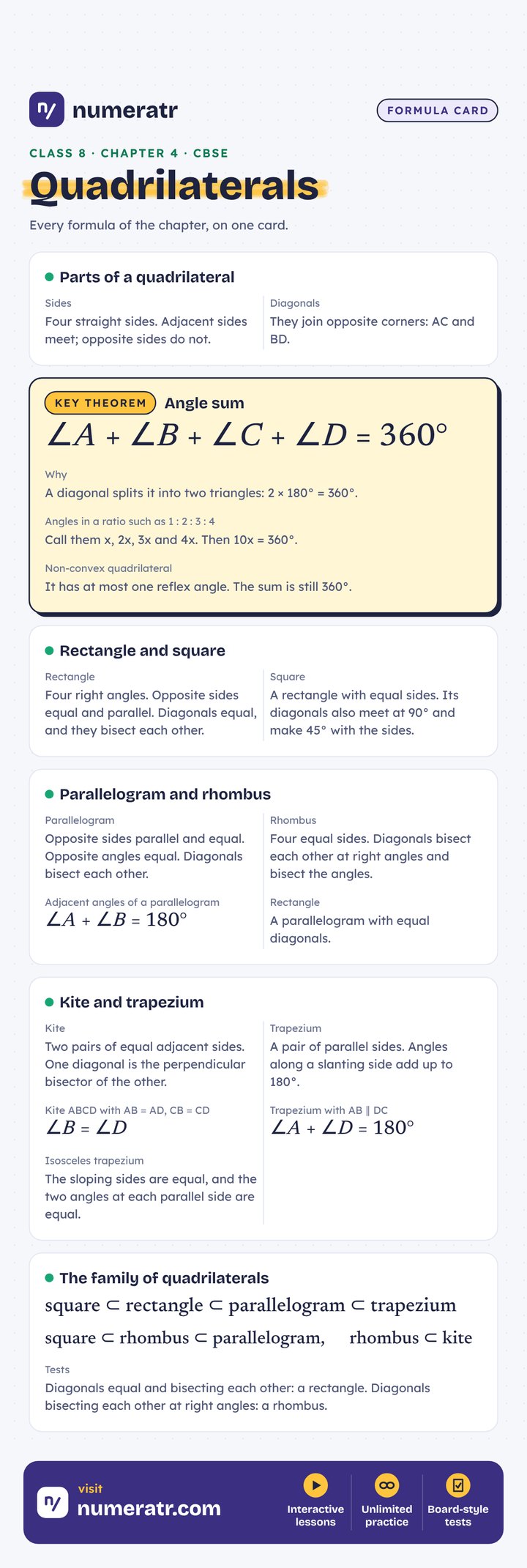
Learn, practise, test
Every chapter on Numeratr follows the same three steps.
- 1Learn
Short stories and animated pictures explain each idea. After every idea, your child tries a question.
- 2Practise
Practice that adapts from Easy to Challenge, by pattern, or ten at a time. Hints and a full solution for every question.
- 3Test
An exam-style chapter test, sections A to E in the CBSE paper pattern. Fresh numbers every time.
Try three questions
From a starter to a challenge. Have a go before you open the answer.
Three angles of a quadrilateral are 75°, 110° and 95°. Find the fourth angle.
Show the answerHide the answer
80°
- The four angles add up to 360°.
- 360° − (75° + 110° + 95°) = 360° − 280° = 80°.
The angles of a quadrilateral are in the ratio 2 : 3 : 5 : 8. Find the largest angle.
Show the answerHide the answer
160°
- Call the angles 2x, 3x, 5x and 8x. Then 18x = 360°, so x = 20°.
- The largest angle is 8x = 160°.
In parallelogram ABCD, ∠A = (3x + 15)° and ∠B = (2x + 5)°. Find all four angles.
Show the answerHide the answer
∠A = ∠C = 111°, ∠B = ∠D = 69°
- Adjacent angles of a parallelogram add up to 180°: 3x + 15 + 2x + 5 = 180.
- 5x = 160, so x = 32. Then ∠A = 111° and ∠B = 69°.
- Opposite angles are equal, so ∠C = 111° and ∠D = 69°.
Learn Quadrilaterals the right way
Interactive lessons, endless practice that adapts, and tests with a fresh paper every time. Children earn NerdCoins for real effort, and parents get a clear report.
This chapter is free: sign in and start.