Chapter guides › Class 8 maths
CBSE Class 8 maths · Chapter 10
Ratios, Scale and Inverse Proportion
Ratios with three terms, map scales and scale drawings, pie charts, and inverse proportion for work and time problems, for the new CBSE Class 8 book.
- Ganita Prakash Part II, Chapter 3
- 4 interactive lessons
- Endless practice
- exam-style test
About this chapter
Ratios, Scale and Inverse Proportion follows ‘Proportional Reasoning–2’, the third chapter of Part II of the new NCERT book Ganita Prakash for CBSE Class 8. It extends ratios to three terms, for mixtures and for sharing among three people.
The chapter goes on to map scales and scale drawings, pie charts as ratios of 360°, and inverse proportion, where one quantity goes up as the other goes down and their product stays the same, as with workers and days.
Key results and formulas
- Sharing in a : b : c
- one part = total ÷ (a + b + c)
- Linking ratios
- Make the shared term equal: a : b and b : c become one ratio a : b : c.
- Map scale 1 : n
- ground distance = map distance × n
- Pie chart angle
- angle = group ÷ total × 360°
- Inverse proportion
- x × y = k (constant)
- Work and time
- total work = workers × days
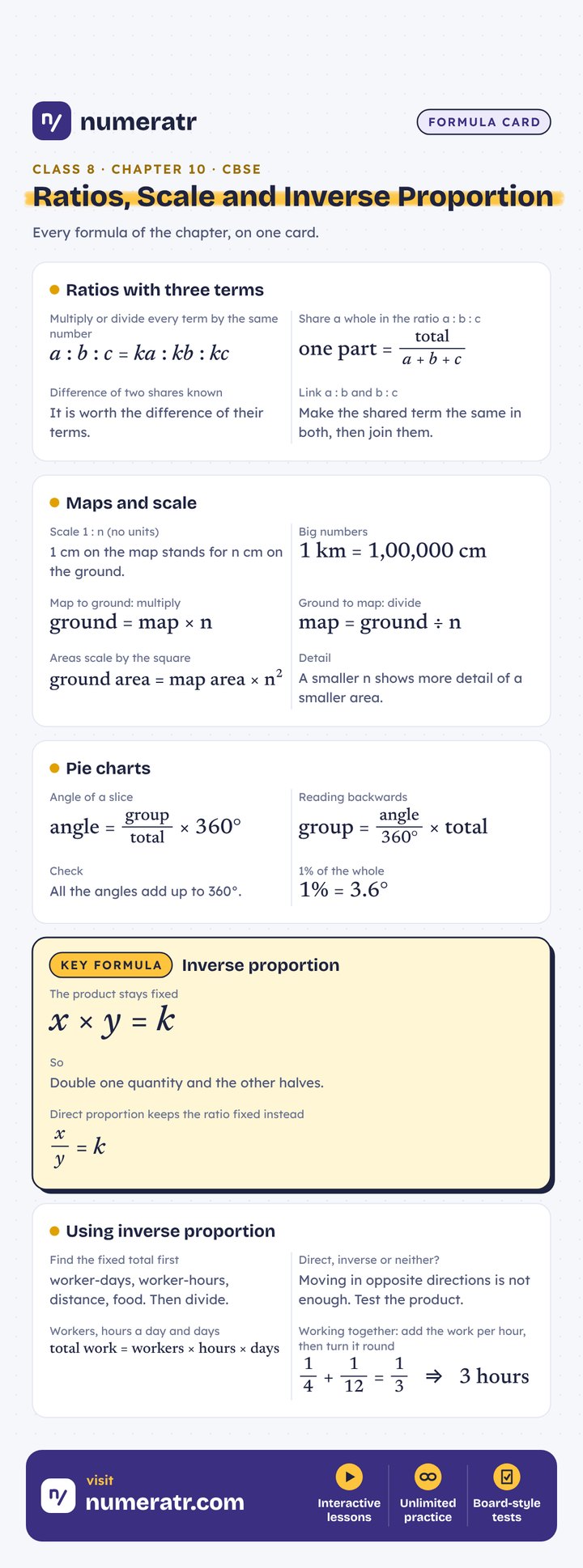
Every formula of Ratios, Scale and Inverse Proportion on one card
A free revision card, made to be saved and shared. It covers:
- Sharing in a : b : c
- Linking ratios
- Map scale 1 : n
- Pie chart angle
- Inverse proportion
- Work and time
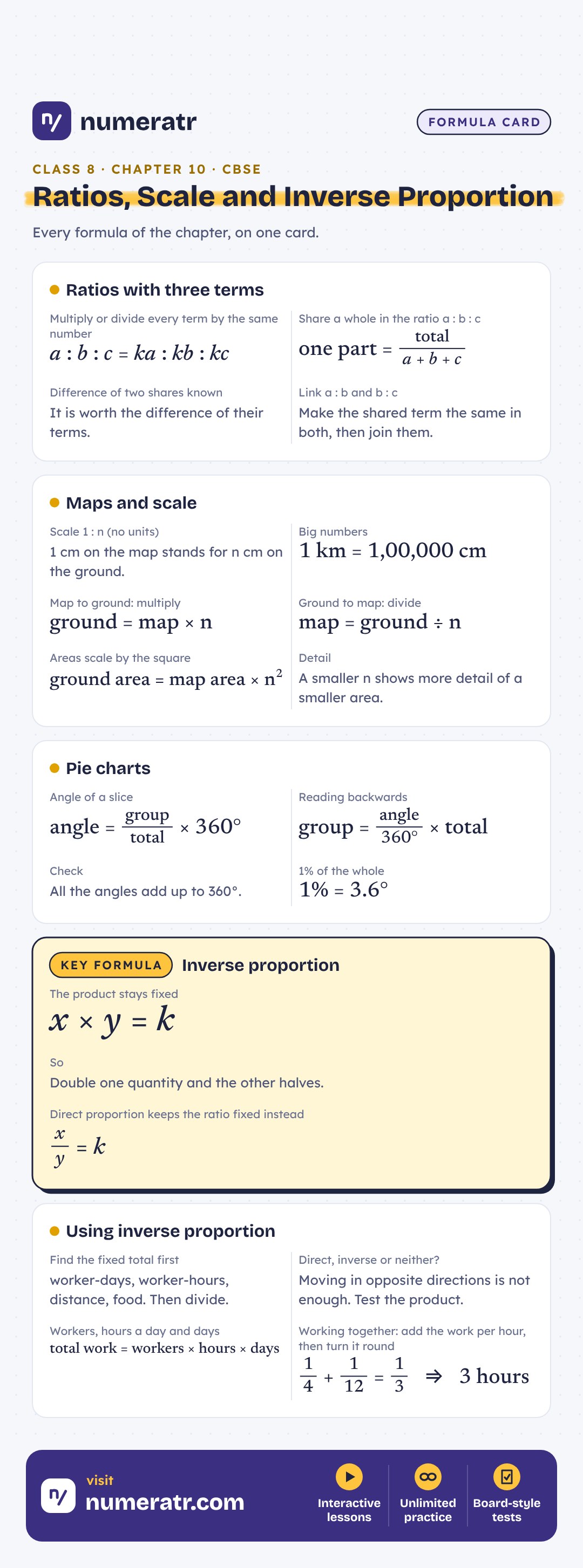
Free to share with friends and study groups.
Learn, practise, test
Every chapter on Numeratr follows the same three steps.
- 1Learn
Short stories and animated pictures explain each idea. After every idea, your child tries a question.
- 2Practise
Practice that adapts from Easy to Challenge, by pattern, or ten at a time. Hints and a full solution for every question.
- 3Test
An exam-style chapter test, sections A to E in the CBSE paper pattern. Fresh numbers every time.
Try three questions
From a starter to a challenge. Have a go before you open the answer.
Share ₹9,000 in the ratio 2 : 3 : 4.
Show the answerHide the answer
₹2,000, ₹3,000 and ₹4,000
- There are 2 + 3 + 4 = 9 parts, so one part is 9000 ÷ 9 = ₹1,000.
- The shares are ₹2,000, ₹3,000 and ₹4,000.
12 workers can build a wall in 10 days. How long would 15 workers take?
Show the answerHide the answer
8 days
- The total work is 12 × 10 = 120 worker-days.
- 15 workers take 120 ÷ 15 = 8 days.
If a : b = 2 : 3 and b : c = 4 : 5, find a : b : c.
Show the answerHide the answer
8 : 12 : 15
- Make b the same in both: 2 : 3 = 8 : 12 and 4 : 5 = 12 : 15.
- So a : b : c = 8 : 12 : 15.
Learn Ratios, Scale and Inverse Proportion the right way
Interactive lessons, endless practice that adapts, and tests with a fresh paper every time. Children earn NerdCoins for real effort, and parents get a clear report.
One chapter in every class is free.