Chapter guides › Class 8 maths
CBSE Class 8 maths · Chapter 1
Squares, Cubes and Their Roots
Square numbers and their patterns, square roots by subtraction, prime factors and estimation, cubes, cube roots and the taxicab number 1729, for the new CBSE Class 8 book.
- Ganita Prakash Part I, Chapter 1
- 5 interactive lessons
- Endless practice
- exam-style test
About this chapter
Squares, Cubes and Their Roots is Chapter 1 of CBSE Class 8 maths, called ‘A Square and a Cube’ in the new NCERT book Ganita Prakash. It starts with square numbers: which numbers can fill a square, and how their last digits, zeros and factors give them away.
The chapter goes on to the patterns hidden in squares (odd numbers, triangular numbers), three ways to find a square root and how to estimate one, then cubes, cube roots by grouping prime factors, and Ramanujan's taxicab number.
Key results and formulas
- Square and cube
- n² = n × n, n³ = n × n × n
- Last digit of a square
- Always 0, 1, 4, 5, 6 or 9. Never 2, 3, 7 or 8.
- Sum of the first n odd numbers
- 1 + 3 + 5 + … + (2n − 1) = n²
- Square root by prime factors
- Pair up equal primes; take one from each pair.
- Estimating a root
- If m² < a < (m + 1)², then m < √a < m + 1.
- Cube root by prime factors
- Group equal primes in threes; take one from each group.
- Taxicab number
- 1729 = 1³ + 12³ = 9³ + 10³
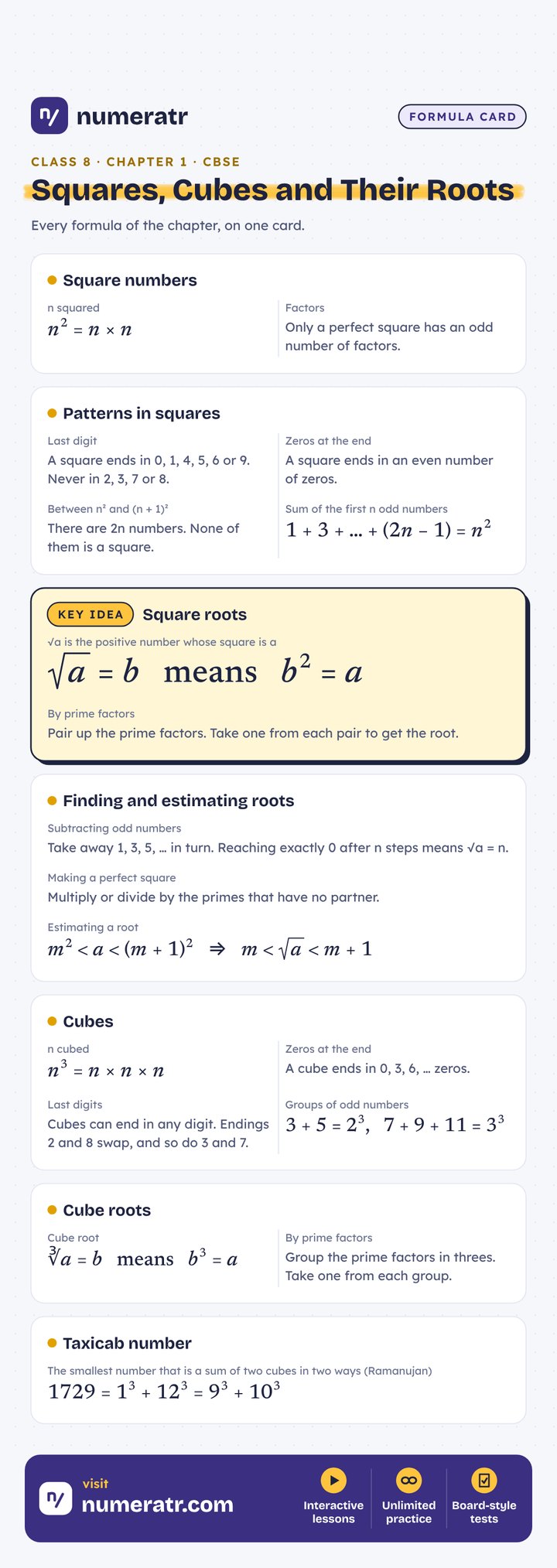
Every formula of Squares, Cubes and Their Roots on one card
A free revision card, made to be saved and shared. It covers:
- Square and cube
- Last digit of a square
- Sum of the first n odd numbers
- Square root by prime factors
- Estimating a root
- Cube root by prime factors
- Taxicab number
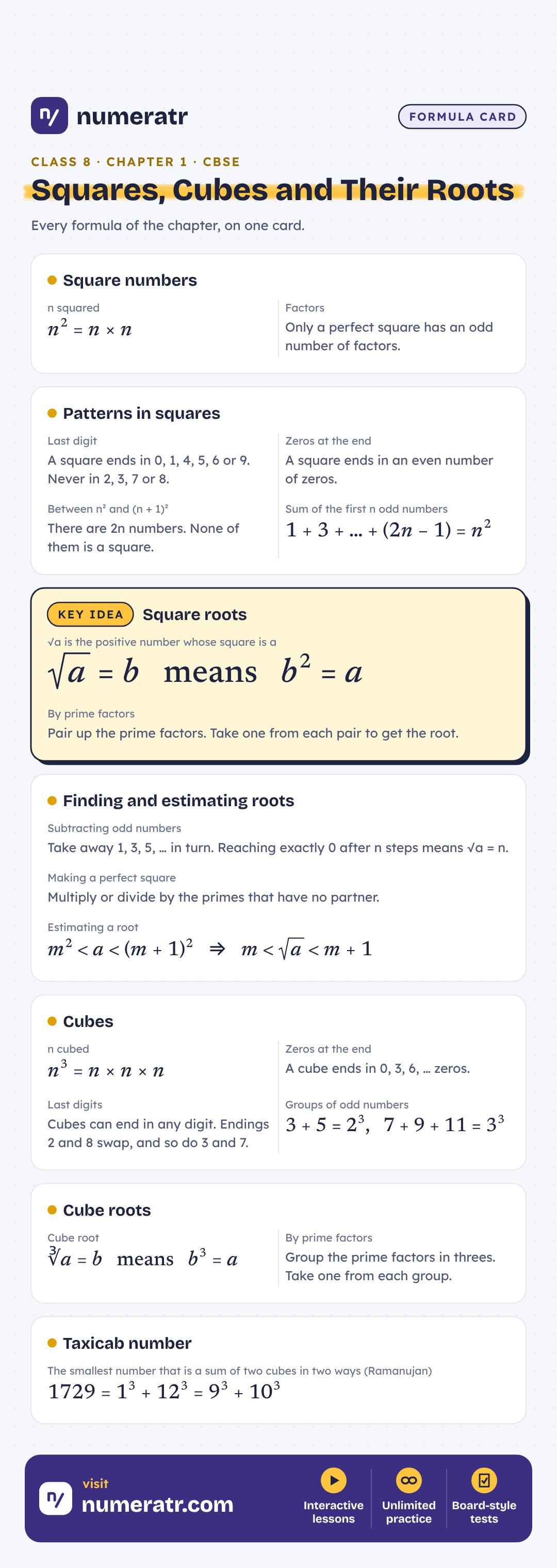
Free to share with friends and study groups.
Learn, practise, test
Every chapter on Numeratr follows the same three steps.
- 1Learn
Short stories and animated pictures explain each idea. After every idea, your child tries a question.
- 2Practise
Practice that adapts from Easy to Challenge, by pattern, or ten at a time. Hints and a full solution for every question.
- 3Test
An exam-style chapter test, sections A to E in the CBSE paper pattern. Fresh numbers every time.
Try three questions
From a starter to a challenge. Have a go before you open the answer.
Find the square root of 1,764 using prime factors.
Show the answerHide the answer
42
- 1764 = 2 × 2 × 3 × 3 × 7 × 7, and every prime pairs up.
- Take one from each pair: √1764 = 2 × 3 × 7 = 42.
Find the smallest number by which 2,700 must be multiplied to make a perfect cube. What is the cube root of the product?
Show the answerHide the answer
Multiply by 10; the cube root of 27,000 is 30
- 2700 = 2 × 2 × 3 × 3 × 3 × 5 × 5.
- The 2s and the 5s each need one more to make a group of three, so multiply by 2 × 5 = 10.
- 2700 × 10 = 27000 = 2³ × 3³ × 5³, so its cube root is 2 × 3 × 5 = 30.
4,913 is the cube of a two-digit number. Find the number without dividing.
Show the answerHide the answer
17
- A cube ending in 3 comes from a number ending in 7 (endings 3 and 7 swap).
- 4 lies between 1³ = 1 and 2³ = 8, so the tens digit is 1.
- The number is 17. Check: 17 × 17 × 17 = 289 × 17 = 4913.
Learn Squares, Cubes and Their Roots the right way
Interactive lessons, endless practice that adapts, and tests with a fresh paper every time. Children earn NerdCoins for real effort, and parents get a clear report.
One chapter in every class is free.