Chapter guides › Class 8 maths
CBSE Class 8 maths · Chapter 11
Visualising Solid Shapes
Fractals and the Koch snowflake, faces, edges and vertices, nets of solids, views and projections, isometric drawing and the shortest path on a box, for the new CBSE Class 8 book.
- Ganita Prakash Part II, Chapter 4
- 4 interactive lessons
- Endless practice
- exam-style test
About this chapter
Visualising Solid Shapes follows ‘Exploring Some Geometric Themes’, the fourth chapter of Part II of the new NCERT book Ganita Prakash for CBSE Class 8. It opens with fractals, shapes built by repeating one rule, such as the Koch snowflake.
The chapter then turns to solids: Euler's formula for faces, vertices and edges, nets that fold into cubes and other solids, front, side and top views of stacks of cubes, isometric drawing, and finding the shortest path over the surface of a box by unfolding it.
Key results and formulas
- Euler's formula
- F + V − E = 2
- Koch snowflake
- Sides after step n: 3 × 4ⁿ; each step multiplies the perimeter by 4/3.
- Nets of a cube
- There are 11 different nets.
- Opposite faces of a die
- They add up to 7.
- Views of a stack
- Front: the tallest pile in each column. Side: the tallest pile in each row.
- Shortest path on a box
- Unfold the faces; the path is a straight line of length √(p² + q²).
Every formula of Visualising Solid Shapes on one card
A free revision card, made to be saved and shared. It covers:
- Euler's formula
- Koch snowflake
- Nets of a cube
- Opposite faces of a die
- Views of a stack
- Shortest path on a box
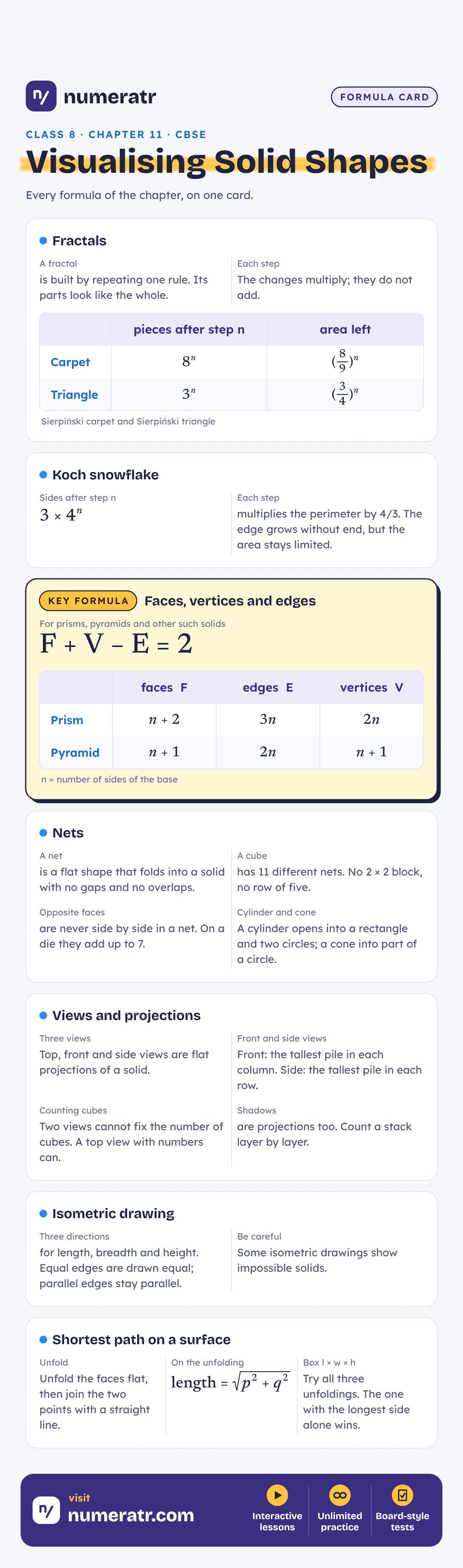
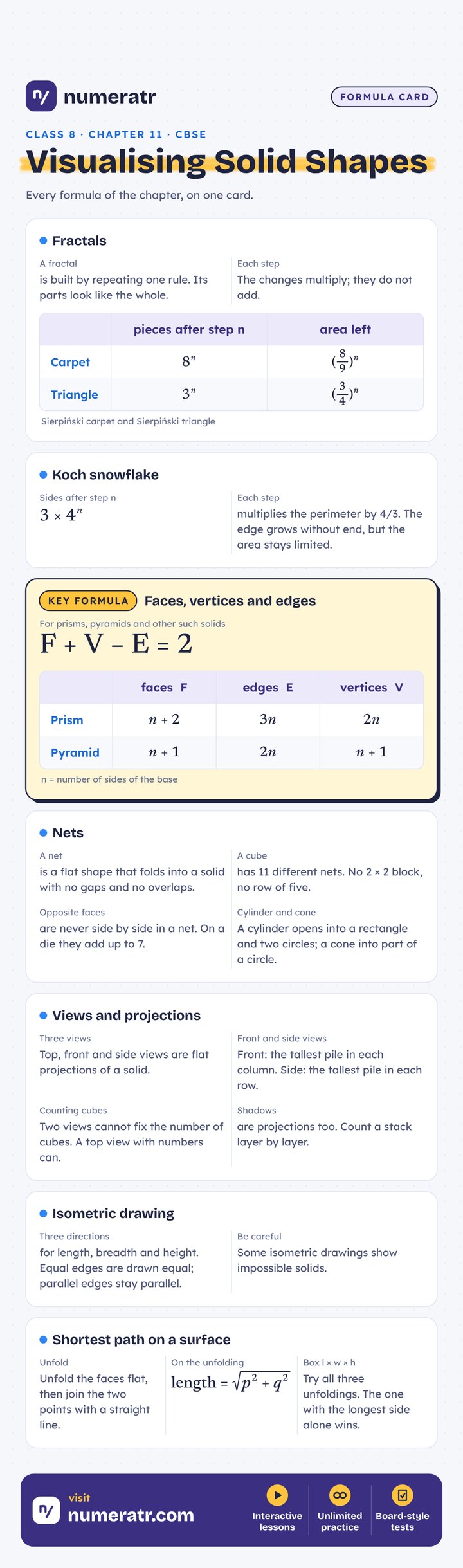
Free to share with friends and study groups.
Learn, practise, test
Every chapter on Numeratr follows the same three steps.
- 1Learn
Short stories and animated pictures explain each idea. After every idea, your child tries a question.
- 2Practise
Practice that adapts from Easy to Challenge, by pattern, or ten at a time. Hints and a full solution for every question.
- 3Test
An exam-style chapter test, sections A to E in the CBSE paper pattern. Fresh numbers every time.
Try three questions
From a starter to a challenge. Have a go before you open the answer.
A solid has 8 faces and 12 vertices. How many edges does it have?
Show the answerHide the answer
18 edges
- Euler's formula: F + V − E = 2.
- 8 + 12 − E = 2, so E = 18.
A Koch snowflake starts from a triangle with perimeter 27 cm. What is its perimeter after 2 steps?
Show the answerHide the answer
48 cm
- Each step multiplies the perimeter by 4/3.
- 27 × 4/3 × 4/3 = 27 × 16/9 = 48 cm.
A box is 6 cm long, 5 cm wide and 3 cm high. An ant walks on the surface from one bottom corner to the opposite top corner. How long is the shortest path?
Show the answerHide the answer
10 cm
- Unfold two faces in each of the three ways and join the corners with a straight line.
- The three lengths are √((5 + 3)² + 6²) = √100, √((6 + 3)² + 5²) = √106 and √((6 + 5)² + 3²) = √130.
- The shortest is √100 = 10 cm.
Learn Visualising Solid Shapes the right way
Interactive lessons, endless practice that adapts, and tests with a fresh paper every time. Children earn NerdCoins for real effort, and parents get a clear report.
One chapter in every class is free.