Chapter guides › Class 9 maths
CBSE Class 9 maths · Chapter 11
Algorithms: HCF and LCM
What an algorithm is, column addition, divisors, the GCD (HCF) and LCM, making an algorithm faster, and the algorithms of Euclid and Āryabhaṭa.
- Ganita Manjari Chapter 11
- 4 interactive lessons
- Endless practice
- exam-style test
About this chapter
Algorithms: HCF and LCM is Chapter 11 of CBSE Class 9 maths, called ‘The World of Algorithms’ in the new NCERT book Ganita Manjari. An algorithm is a list of exact steps that always gives the right answer and always stops.
The chapter looks closely at column addition, listing divisors, and finding the greatest common divisor (GCD, also called HCF) and the LCM. It asks how to make an algorithm faster, and ends with two famous GCD methods: Euclid’s by subtraction and Āryabhaṭa’s by division.
Key results and formulas
- GCD and LCM
- gcd(m, n) × lcm(m, n) = m × n
- Divisor pairs
- Divisors of n come in pairs j and n/j, so testing j up to √n is enough.
- Euclid’s subtraction algorithm
- gcd(m, n) = gcd(n, m − n), repeated until a pair (g, 0).
- Āryabhaṭa’s division algorithm
- gcd(m, n) = gcd(n, m mod n), repeated until a pair (g, 0).
- m mod n
- The remainder when m is divided by n.
- Column addition
- With two numbers, the carry into the next column is always 0 or 1.
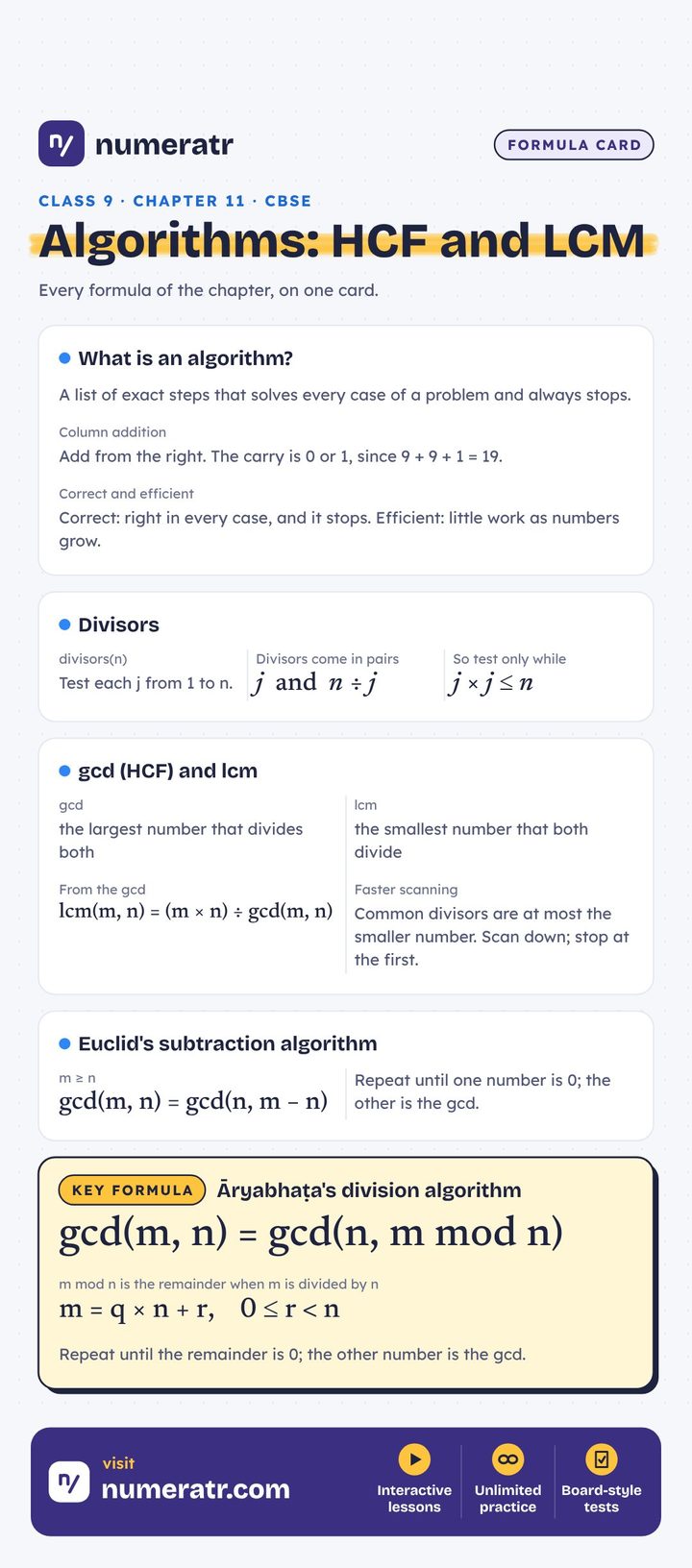
Every formula of Algorithms: HCF and LCM on one card
A free revision card, made to be saved and shared. It covers:
- GCD and LCM
- Divisor pairs
- Euclid’s subtraction algorithm
- Āryabhaṭa’s division algorithm
- m mod n
- Column addition
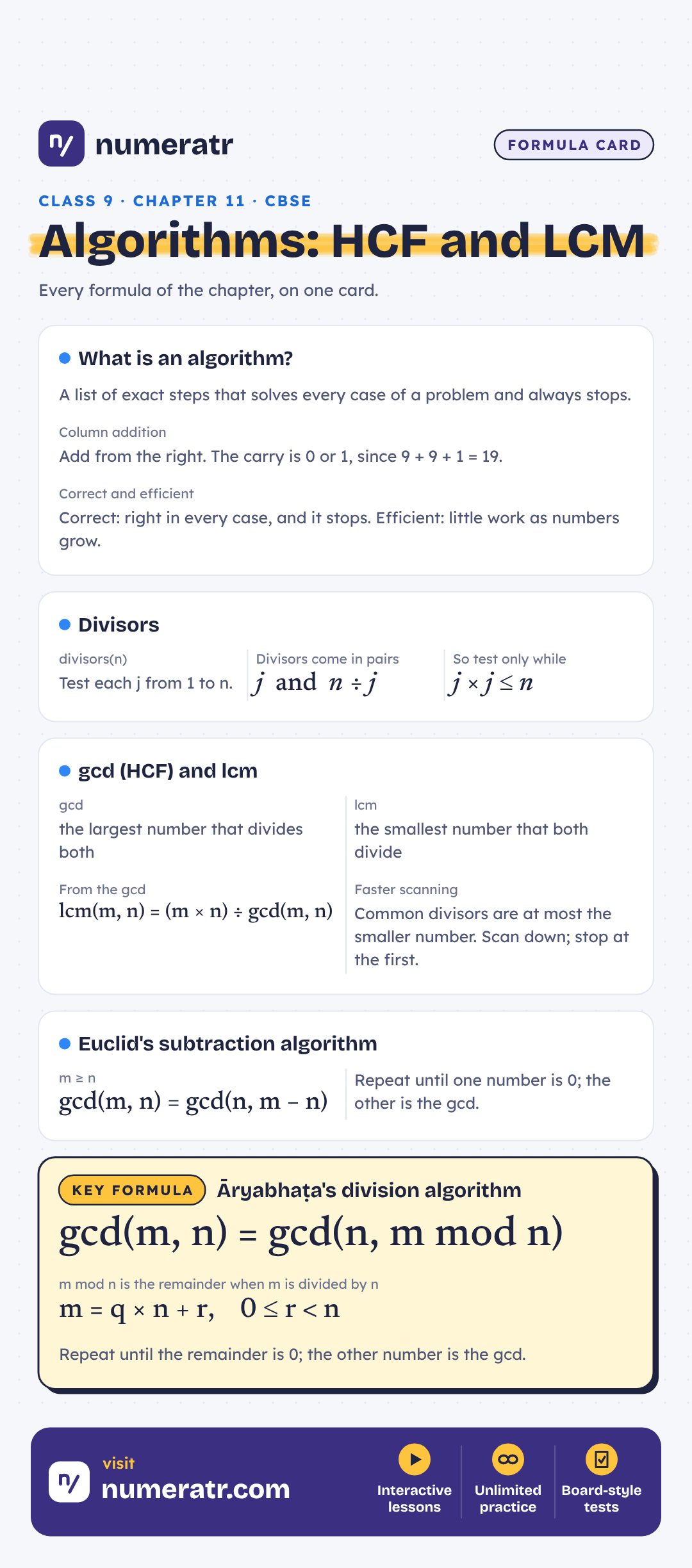
Free to share with friends and study groups.
Learn, practise, test
Every chapter on Numeratr follows the same three steps.
- 1Learn
Short stories and animated pictures explain each idea. After every idea, your child tries a question.
- 2Practise
Practice that adapts from Easy to Challenge, by pattern, or ten at a time. Hints and a full solution for every question.
- 3Test
An exam-style chapter test, sections A to E in the CBSE paper pattern. Fresh numbers every time.
Try three questions
From a starter to a challenge. Have a go before you open the answer.
gcd(12, 30) = 6. Use lcm(m, n) = m × n ÷ gcd(m, n) to find lcm(12, 30).
Show the answerHide the answer
60
- 12 × 30 = 360.
- 360 ÷ 6 = 60.
Use Āryabhaṭa’s algorithm, gcd(m, n) = gcd(n, m mod n), to find gcd(1001, 637).
Show the answerHide the answer
91
- (1001, 637) → (637, 364) → (364, 273) → (273, 91) → (91, 0).
- The last non-zero number is 91.
How many steps does Euclid’s subtraction algorithm take for (100, 7), if each replacement of the pair is one step and it stops at a pair (g, 0)?
Show the answerHide the answer
19
- 14 subtractions of 7 take (100, 7) to (7, 2), since 100 − 98 = 2.
- Then (7, 2) → (5, 2) → (3, 2) → (2, 1) → (1, 1) → (1, 0): 5 more.
- 14 + 5 = 19 steps. Āryabhaṭa’s division method needs only 3.
Learn Algorithms: HCF and LCM the right way
Interactive lessons, endless practice that adapts, and tests with a fresh paper every time. Children earn NerdCoins for real effort, and parents get a clear report.
One chapter in every class is free.