Chapter guides › Class 9 maths
CBSE Class 9 maths · Chapter 2
Introduction to Linear Polynomials
Polynomials and their degree, linear polynomials, solving linear equations, linear growth and decay, and the graph of y = ax + b.
- Ganita Manjari Chapter 2
- 4 interactive lessons
- Endless practice
- exam-style test
About this chapter
Introduction to Linear Polynomials is Chapter 2 of CBSE Class 9 maths in the new NCERT book Ganita Manjari. It starts with what a polynomial is (terms, coefficients, degree) and then focuses on the simplest kind, ax + b.
Students solve linear equations from real problems, spot patterns that grow or shrink by the same step each time, find a rule from two data points, and draw y = ax + b, reading off its slope and where it crosses the axes.
Key results and formulas
- Polynomial in x
- A sum of terms axⁿ where each power n is a whole number.
- Degree
- The highest power of x with a non-zero coefficient.
- Linear polynomial
- ax + b, with a ≠ 0. Its zero is x = −b/a.
- Linear pattern
- Grows (or shrinks) by the same amount each step: term n = (step) × n + (start − step).
- Graph of y = ax + b
- A straight line: a is the slope, b is where it crosses the y-axis.
- Slope from two points
- (y₂ − y₁) ÷ (x₂ − x₁)
Every formula of Introduction to Linear Polynomials on one card
A free revision card, made to be saved and shared. It covers:
- Polynomial in x
- Degree
- Linear polynomial
- Linear pattern
- Graph of y = ax + b
- Slope from two points
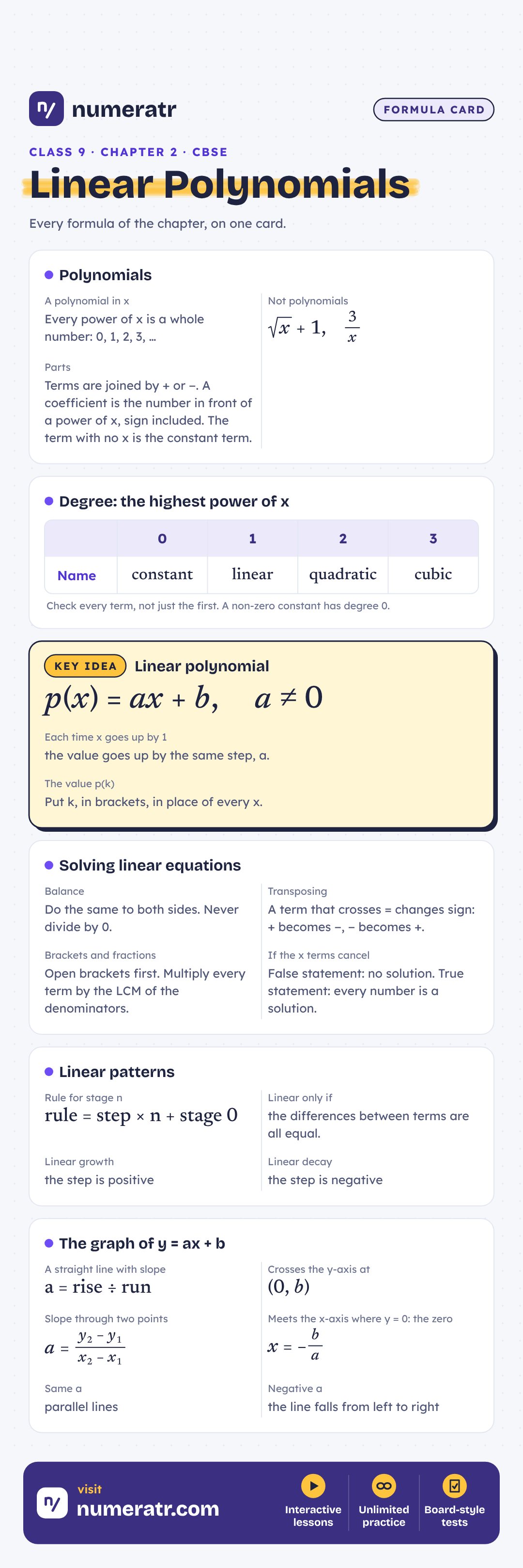
Free to share with friends and study groups.
Learn, practise, test
Every chapter on Numeratr follows the same three steps.
- 1Learn
Short stories and animated pictures explain each idea. After every idea, your child tries a question.
- 2Practise
Practice that adapts from Easy to Challenge, by pattern, or ten at a time. Hints and a full solution for every question.
- 3Test
An exam-style chapter test, sections A to E in the CBSE paper pattern. Fresh numbers every time.
Try three questions
From a starter to a challenge. Have a go before you open the answer.
Find the slope of the line through (1, −2) and (5, 18).
Show the answerHide the answer
5
- Slope = (18 − (−2)) ÷ (5 − 1) = 20 ÷ 4.
- = 5.
A purse has 20 coins, some of ₹10 and the rest of ₹5, worth ₹140 in all. How many ₹10 coins are there?
Show the answerHide the answer
8
- Let there be x coins of ₹10, so 20 − x coins of ₹5.
- 10x + 5(20 − x) = 140 gives 5x = 40.
- x = 8: 8 coins of ₹10 and 12 of ₹5.
For every a ≠ 0, the line y = ax − 3a + 2 passes through the same point (h, 2). Find h.
Show the answerHide the answer
3
- Put y = 2: 2 = ax − 3a + 2, so a(x − 3) = 0.
- Since a ≠ 0, x = 3.
- h = 3: every such line passes through (3, 2).
Learn Introduction to Linear Polynomials the right way
Interactive lessons, endless practice that adapts, and tests with a fresh paper every time. Children earn NerdCoins for real effort, and parents get a clear report.
One chapter in every class is free.