Chapter guides › Class 9 maths
CBSE Class 9 maths · Chapter 7
Probability
Chance from 0 to 1, experimental probability, sample spaces and equally likely outcomes, tree diagrams, and probability from areas and tables.
- Ganita Manjari Chapter 7
- 4 interactive lessons
- Endless practice
- exam-style test
About this chapter
Probability is Chapter 7 of CBSE Class 9 maths, called ‘The Mathematics of Maybe’ in the new NCERT book Ganita Manjari. It measures chance on a scale from 0 (impossible) to 1 (certain).
The chapter starts with experiments, where probability is estimated from many trials, then moves to equally likely outcomes, sample spaces, counting outcomes, tree diagrams for draws with and without replacement, and probabilities from areas, spinners and tables.
Key results and formulas
- Experimental probability
- number of times the event happened ÷ number of trials
- Equally likely outcomes
- P(E) = number of favourable outcomes ÷ total number of outcomes
- Not happening
- P(not E) = 1 − P(E)
- Counting outcomes
- Two steps with m and n outcomes give m × n outcomes.
- Tree diagrams
- Multiply along a path; add the paths that give the event.
- Geometric probability
- favourable area (or angle) ÷ total area (or 360°)
Every formula of Probability on one card
A free revision card, made to be saved and shared. It covers:
- Experimental probability
- Equally likely outcomes
- Not happening
- Counting outcomes
- Tree diagrams
- Geometric probability
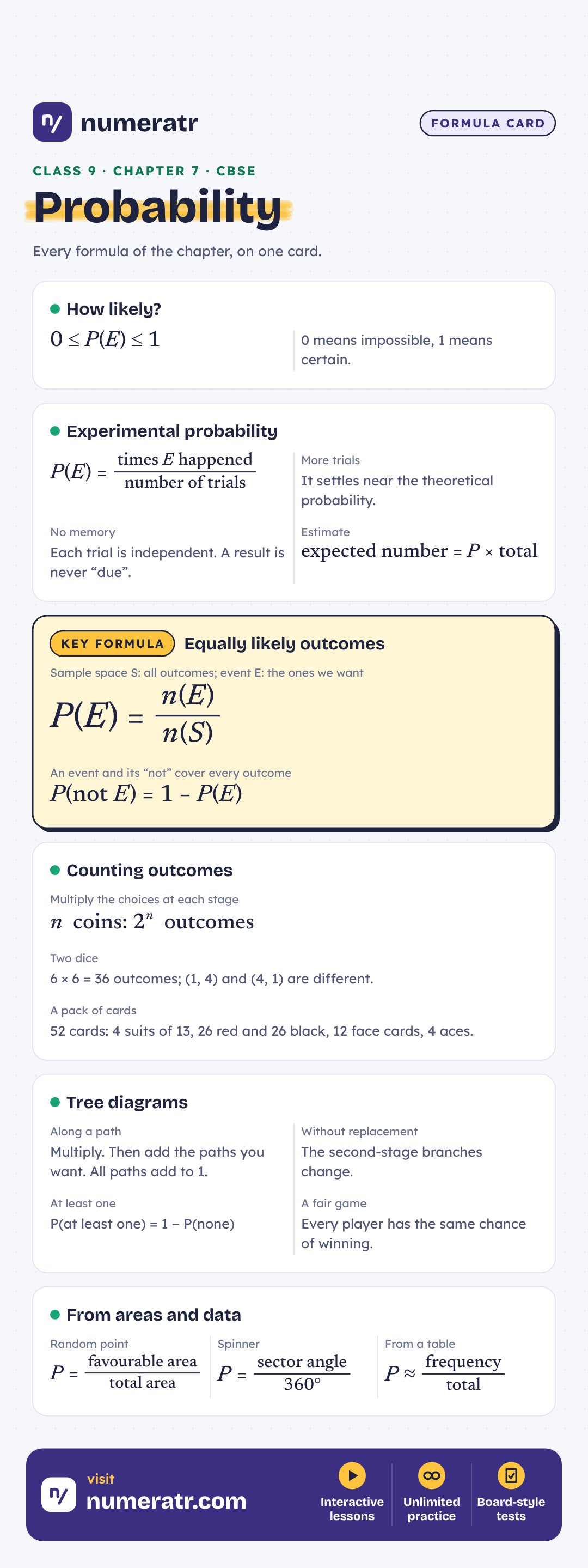
Free to share with friends and study groups.
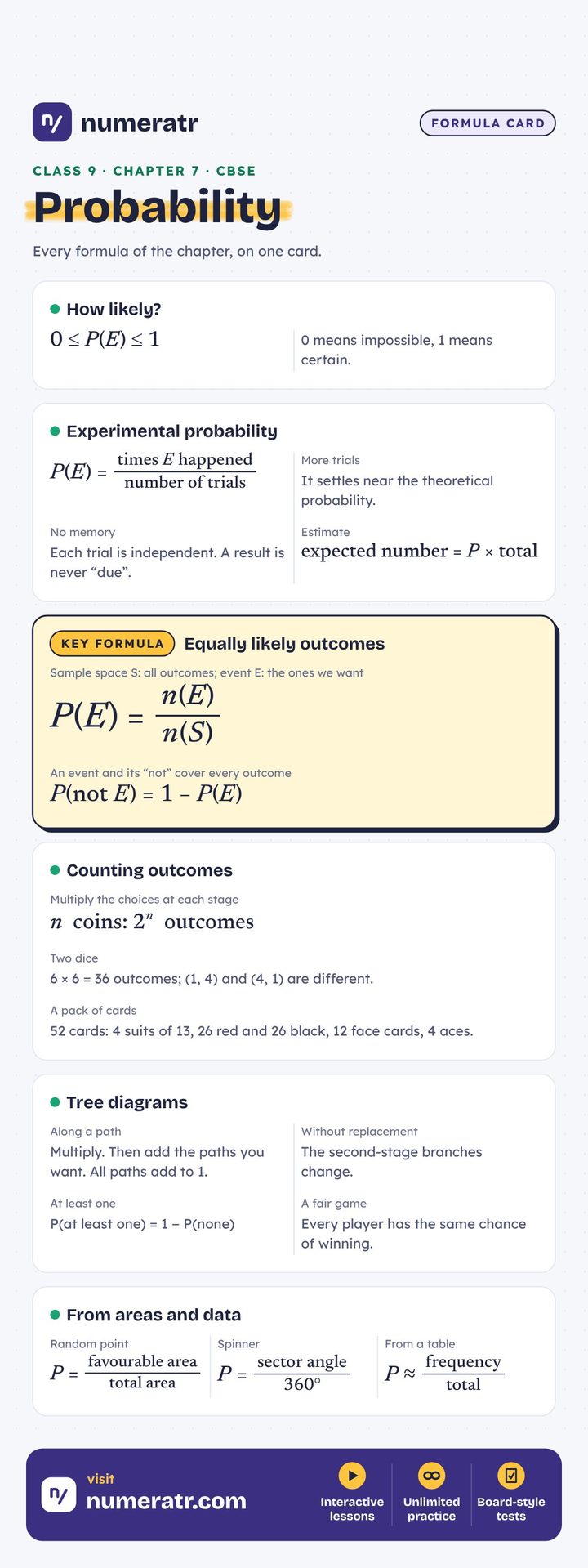
Learn, practise, test
Every chapter on Numeratr follows the same three steps.
- 1Learn
Short stories and animated pictures explain each idea. After every idea, your child tries a question.
- 2Practise
Practice that adapts from Easy to Challenge, by pattern, or ten at a time. Hints and a full solution for every question.
- 3Test
An exam-style chapter test, sections A to E in the CBSE paper pattern. Fresh numbers every time.
Try three questions
From a starter to a challenge. Have a go before you open the answer.
A spinner was spun 120 times and stopped on blue 45 times. Find the experimental probability of blue.
Show the answerHide the answer
3/8
- 45 ÷ 120 = 3/8.
A bag has 5 red and 3 blue balls. Two are drawn without replacement. Find the probability that both are red.
Show the answerHide the answer
5/14
- First red: 5/8. Then 4 red are left among 7: 4/7.
- 5/8 × 4/7 = 20/56 = 5/14.
A bag has 6 red and 4 blue balls. Two are drawn without replacement. Find the probability that they are of different colours.
Show the answerHide the answer
8/15
- Red then blue: 6/10 × 4/9 = 24/90. Blue then red: 4/10 × 6/9 = 24/90.
- Add the two paths: 48/90 = 8/15.
Learn Probability the right way
Interactive lessons, endless practice that adapts, and tests with a fresh paper every time. Children earn NerdCoins for real effort, and parents get a clear report.
One chapter in every class is free.