Chapter guides › Class 9 maths
CBSE Class 9 maths · Chapter 9
Propositions and their Converses
Propositions and if–then statements, why examples are not proofs, counterexamples, converses, and converses in geometry.
- Ganita Manjari Chapter 9
- 4 interactive lessons
- Endless practice
- exam-style test
About this chapter
Propositions and their Converses is Chapter 9 of CBSE Class 9 maths in the new NCERT book Ganita Manjari. A proposition is a statement that is either true or false, and many are written in the form ‘if X, then Y’.
The chapter shows that no number of examples proves a statement, while one counterexample disproves it. It then swaps the two parts of an if–then statement to get its converse, and checks each direction separately, with numbers, divisibility, and geometry results such as the Baudhāyana–Pythagoras theorem and its converse.
Key results and formulas
- Proposition
- A statement that is either true or false (not a question or an instruction).
- Converse
- The converse of ‘if X, then Y’ is ‘if Y, then X’. One can be true while the other is false.
- Counterexample
- One case where X is true and Y is false is enough to show ‘if X, then Y’ is false.
- Baudhāyana–Pythagoras and converse
- A triangle is right-angled exactly when a² + b² = c² for its longest side c.
- Isosceles triangles
- Equal sides ⇔ equal opposite angles (both directions true).
- Perfect squares
- A number has an odd number of factors exactly when it is a perfect square.
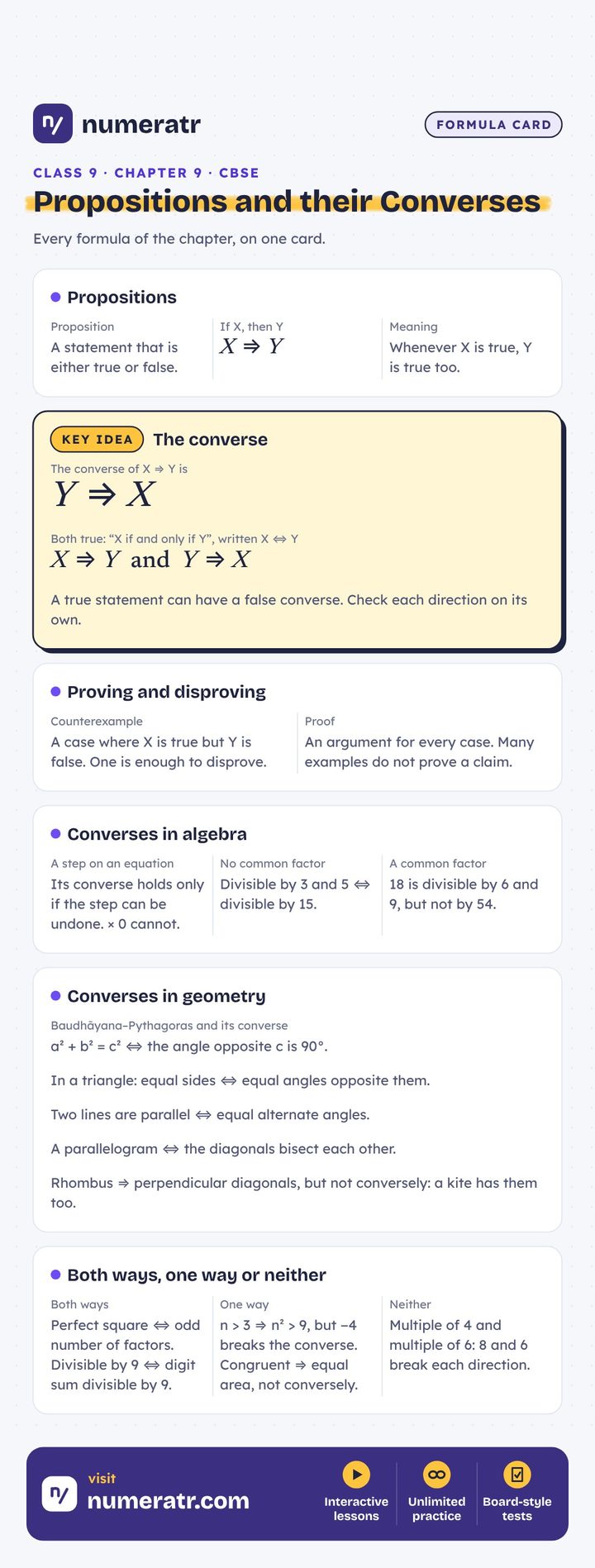
Every formula of Propositions and their Converses on one card
A free revision card, made to be saved and shared. It covers:
- Proposition
- Converse
- Counterexample
- Baudhāyana–Pythagoras and converse
- Isosceles triangles
- Perfect squares
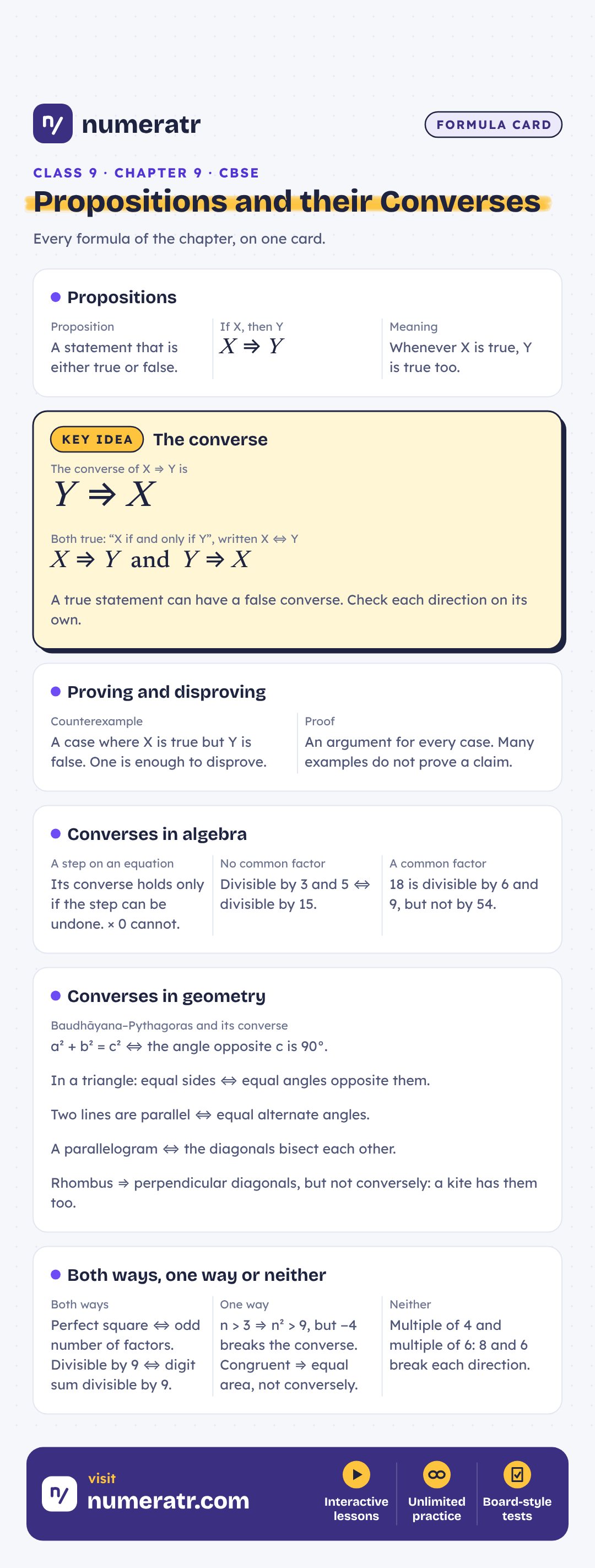
Free to share with friends and study groups.
Learn, practise, test
Every chapter on Numeratr follows the same three steps.
- 1Learn
Short stories and animated pictures explain each idea. After every idea, your child tries a question.
- 2Practise
Practice that adapts from Easy to Challenge, by pattern, or ten at a time. Hints and a full solution for every question.
- 3Test
An exam-style chapter test, sections A to E in the CBSE paper pattern. Fresh numbers every time.
Try three questions
From a starter to a challenge. Have a go before you open the answer.
Claim: 2n² + 5 is prime for every counting number n. Find the smallest n for which it is not prime.
Show the answerHide the answer
5
- For n = 1 to 4 the values 7, 13, 23 and 37 are prime.
- At n = 5: 2 × 25 + 5 = 55 = 5 × 11.
- So n = 5 is a counterexample.
“If 84 divides n, then 6 and 14 divide n.” Find the smallest counting number that shows the converse is false.
Show the answerHide the answer
42
- The converse: if 6 and 14 divide n, then 84 divides n.
- The smallest number divisible by 6 and 14 is their LCM, 42.
- 42 is not divisible by 84, so the converse is false.
How many numbers from 1 to 50 have exactly 3 factors?
Show the answerHide the answer
4
- An odd number of factors means a perfect square; exactly 3 (1, p and p²) means the square of a prime.
- Squares of primes up to 50: 4, 9, 25 and 49.
- There are 4.
Learn Propositions and their Converses the right way
Interactive lessons, endless practice that adapts, and tests with a fresh paper every time. Children earn NerdCoins for real effort, and parents get a clear report.
One chapter in every class is free.