Chapter guides › Class 9 maths
CBSE Class 9 maths · Chapter 12
Quadrilaterals
What counts as a quadrilateral, convex and non-convex shapes, parallelograms and their converses, the midpoint theorem, the centroid and Varignon’s theorem.
- Ganita Manjari Chapter 12
- 4 interactive lessons
- Endless practice
- exam-style test
About this chapter
Quadrilaterals is Chapter 12 of CBSE Class 9 maths in the new NCERT book Ganita Manjari. It starts with an exact definition of a quadrilateral and the difference between convex and non-convex ones, and shows why the angles always add to 360°.
The chapter proves the properties of parallelograms and, just as importantly, their converses, then the midpoint theorem, the 2 : 1 split at the centroid, and Varignon’s theorem: joining the midpoints of any quadrilateral gives a parallelogram.
Key results and formulas
- Angle sum
- The angles of a quadrilateral add to 360°; of an n-sided polygon, (n − 2) × 180°.
- Parallelogram
- Opposite sides equal, opposite angles equal, neighbouring angles add to 180°, diagonals bisect each other; each of these also proves a parallelogram.
- Midpoint theorem
- The segment joining the midpoints of two sides of a triangle is parallel to the third side and half as long.
- Trapezium midline
- Half the sum of the parallel sides.
- Centroid
- Divides each median in the ratio 2 : 1 from the vertex.
- Varignon’s theorem
- The midpoints of the sides of any quadrilateral form a parallelogram with perimeter AC + BD.
- Diagonals of a polygon
- n(n − 3) ÷ 2
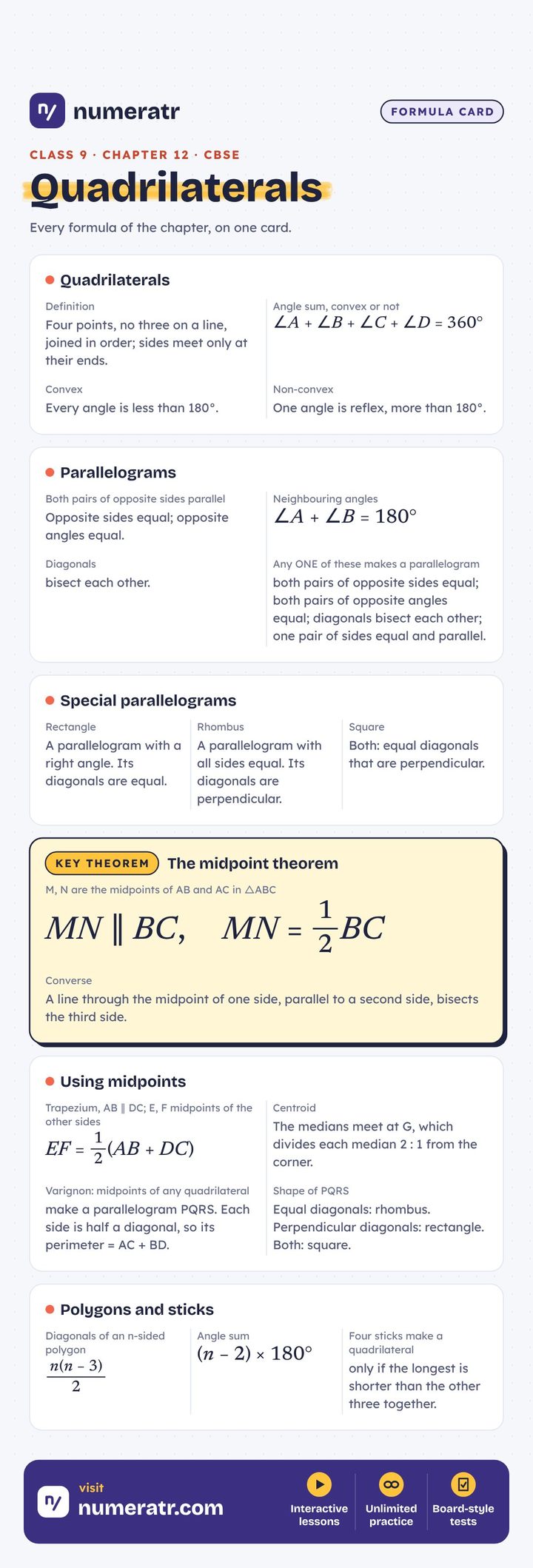
Every formula of Quadrilaterals on one card
A free revision card, made to be saved and shared. It covers:
- Angle sum
- Parallelogram
- Midpoint theorem
- Trapezium midline
- Centroid
- Varignon’s theorem
- Diagonals of a polygon
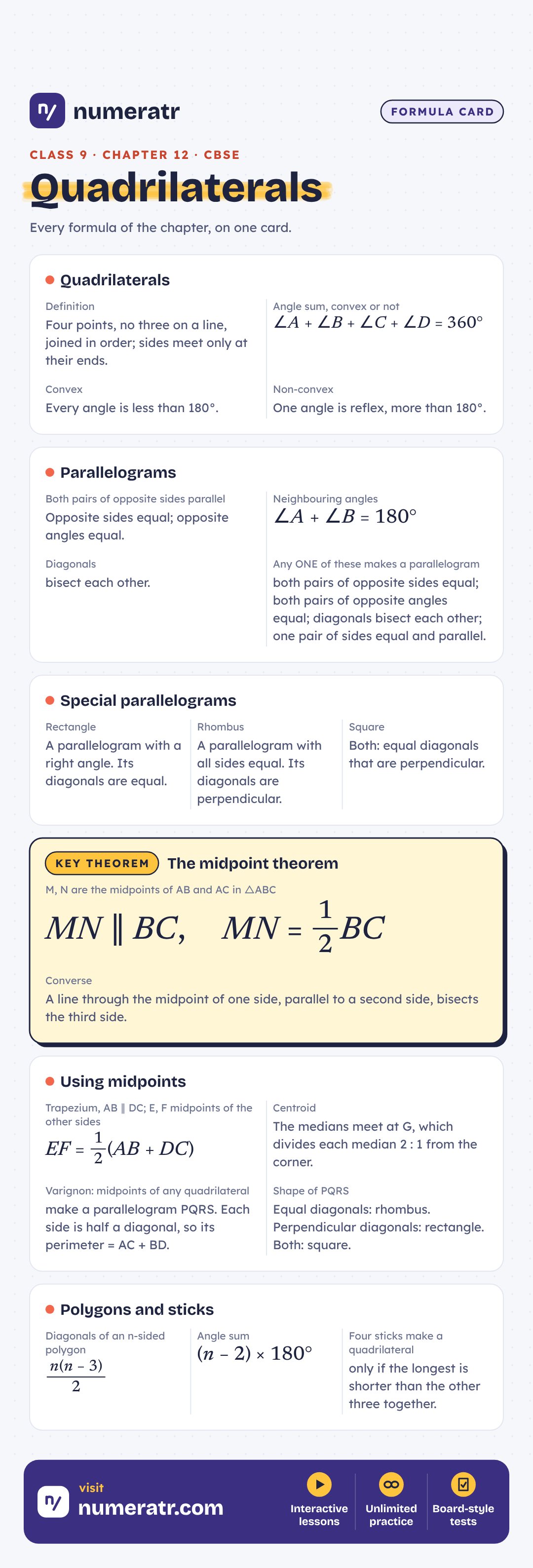
Free to share with friends and study groups.
Learn, practise, test
Every chapter on Numeratr follows the same three steps.
- 1Learn
Short stories and animated pictures explain each idea. After every idea, your child tries a question.
- 2Practise
Practice that adapts from Easy to Challenge, by pattern, or ten at a time. Hints and a full solution for every question.
- 3Test
An exam-style chapter test, sections A to E in the CBSE paper pattern. Fresh numbers every time.
Try three questions
From a starter to a challenge. Have a go before you open the answer.
In triangle ABC, M and N are the midpoints of AB and AC, and BC = 34 cm. Find MN.
Show the answerHide the answer
17 cm
- By the midpoint theorem, MN = ½ BC.
- ½ × 34 = 17 cm.
The diagonals of a rhombus are 40 cm and 42 cm. Find the length of a side.
Show the answerHide the answer
29 cm
- The diagonals of a rhombus bisect each other at right angles, so each side is the hypotenuse of a right triangle with legs 20 cm and 21 cm.
- √(400 + 441) = √841 = 29 cm.
Quadrilateral ABCD has diagonals AC = 18 cm and BD = 24 cm, with AC ⊥ BD. P, Q, R and S are the midpoints of its sides. Find the area of PQRS.
Show the answerHide the answer
108 cm²
- By the midpoint theorem, the sides of PQRS are half the diagonals, 9 cm and 12 cm, and parallel to them.
- AC ⊥ BD, so PQRS is a rectangle.
- Area = 9 × 12 = 108 cm².
Learn Quadrilaterals the right way
Interactive lessons, endless practice that adapts, and tests with a fresh paper every time. Children earn NerdCoins for real effort, and parents get a clear report.
One chapter in every class is free.