Chapter guides › Class 9 maths
CBSE Class 9 maths · Chapter 8
Sequences and Progressions
Sequences and their rules, the Virahānka–Fibonacci numbers, arithmetic progressions and their sums, and geometric progressions.
- Ganita Manjari Chapter 8
- 4 interactive lessons
- Endless practice
- exam-style test
About this chapter
Sequences and Progressions is Chapter 8 of CBSE Class 9 maths, called ‘Predicting What Comes Next’ in the new NCERT book Ganita Manjari. A sequence is a list made by a rule, either a formula for the nth term or a rule that builds each term from the ones before.
The chapter covers the Virahānka–Fibonacci numbers, arithmetic progressions (the nth term, which term has a given value), adding 1 + 2 + … + n by pairing, triangular numbers, and geometric progressions, where each term is multiplied by the same number.
Key results and formulas
- Explicit rule
- A formula for tₙ in terms of n, e.g. tₙ = 6n − 5.
- Recursive rule
- Each term from earlier ones, e.g. tₙ = tₙ₋₁ + tₙ₋₂ (Virahānka–Fibonacci).
- AP: nth term
- tₙ = a + (n − 1)d
- Sums by pairing
- 1 + 2 + … + n = n(n + 1)/2; 1 + 3 + … + (2n − 1) = n²
- AP sum
- number of terms ÷ 2 × (first term + last term)
- GP: nth term
- tₙ = a × rⁿ⁻¹; three terms x, y, z are in GP when y² = xz.
Every formula of Sequences and Progressions on one card
A free revision card, made to be saved and shared. It covers:
- Explicit rule
- Recursive rule
- AP: nth term
- Sums by pairing
- AP sum
- GP: nth term
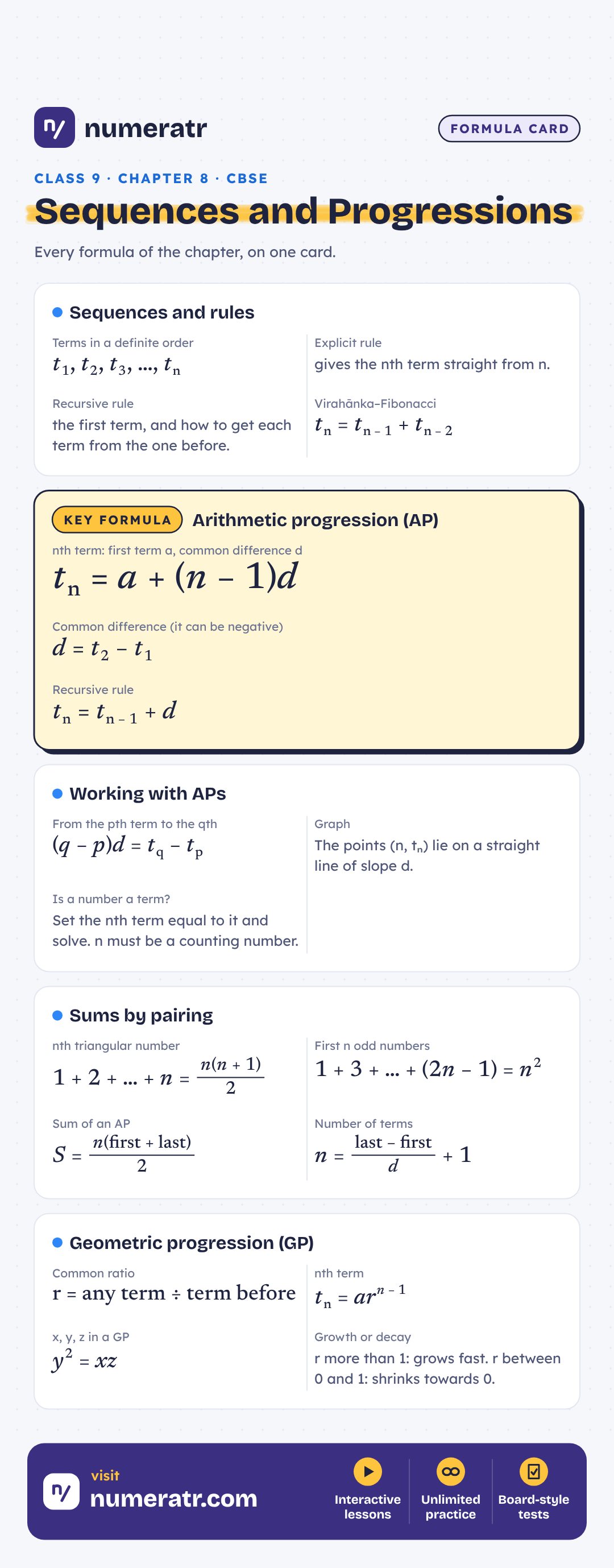
Free to share with friends and study groups.
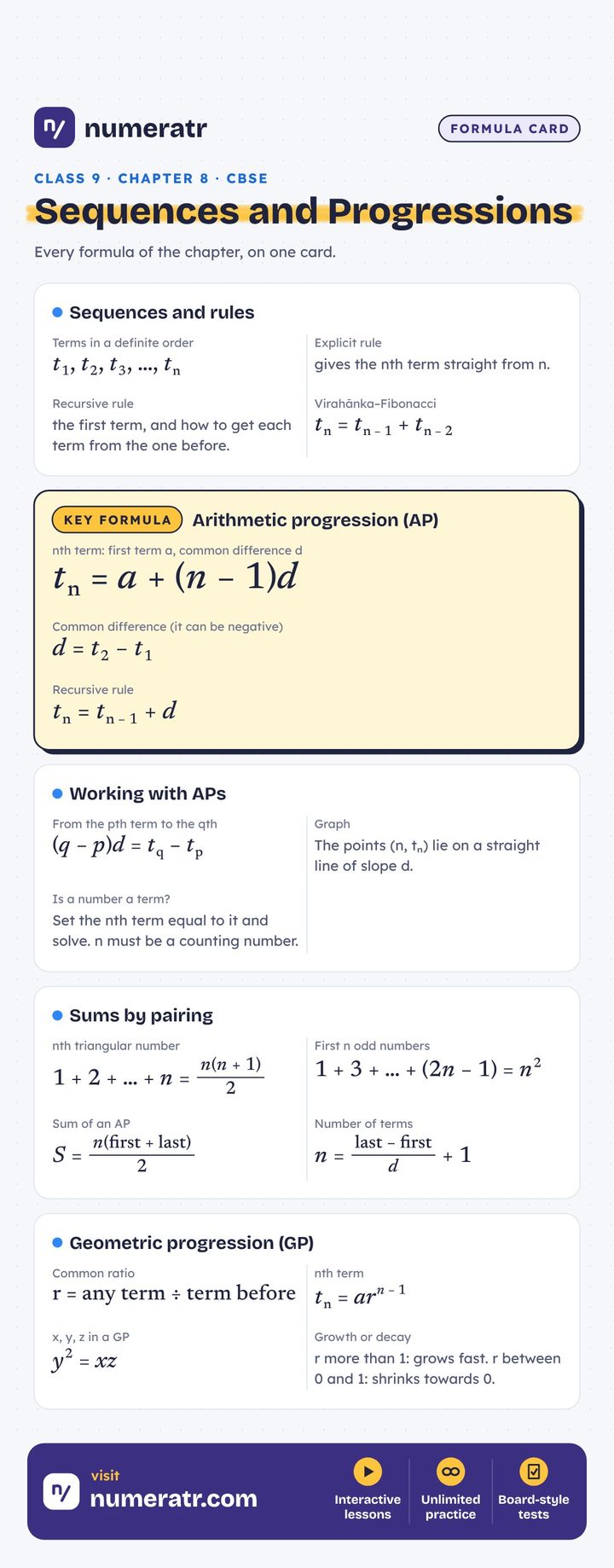
Learn, practise, test
Every chapter on Numeratr follows the same three steps.
- 1Learn
Short stories and animated pictures explain each idea. After every idea, your child tries a question.
- 2Practise
Practice that adapts from Easy to Challenge, by pattern, or ten at a time. Hints and a full solution for every question.
- 3Test
An exam-style chapter test, sections A to E in the CBSE paper pattern. Fresh numbers every time.
Try three questions
From a starter to a challenge. Have a go before you open the answer.
Find the 15th term of the AP 4, 11, 18, ….
Show the answerHide the answer
102
- a = 4 and d = 7.
- t₁₅ = 4 + 14 × 7 = 102.
A new gym has 240 members in its first month and gains 35 members every month. In which month will it have 660 members?
Show the answerHide the answer
Month 13
- 240 + 35(n − 1) = 660, so 35(n − 1) = 420.
- n − 1 = 12, so n = 13.
Rohit climbs a staircase of 10 steps, going up either 1 or 2 steps at a time. In how many different ways can he reach the top?
Show the answerHide the answer
89
- To reach step n, his last move came from step n − 1 or step n − 2, so ways(n) = ways(n − 1) + ways(n − 2).
- Starting 1, 2 for one and two steps: 1, 2, 3, 5, 8, 13, 21, 34, 55, 89.
- 89 ways.
Learn Sequences and Progressions the right way
Interactive lessons, endless practice that adapts, and tests with a fresh paper every time. Children earn NerdCoins for real effort, and parents get a clear report.
One chapter in every class is free.