Chapter guides › Class 9 maths
CBSE Class 9 maths · Chapter 14
Surface Area and Volume
Surface area and volume of cuboids, cylinders, cones, pyramids, spheres and hemispheres, melting and recasting, and what scaling does to them.
- Ganita Manjari Chapter 14
- 4 interactive lessons
- Endless practice
- exam-style test
About this chapter
Surface Area and Volume is Chapter 14 of CBSE Class 9 maths, called ‘Math of Space: Surface Area and Volume’ in the new NCERT book Ganita Manjari. It finds how much card covers a solid and how much it holds.
The chapter works through cuboids, cubes, cylinders, cones, pyramids, spheres and hemispheres, shows where each formula comes from (three cones fill a cylinder, a sphere fits in a tin), and ends with melting one solid into others and what happens to area and volume when a solid is scaled up.
Key results and formulas
- Cuboid and cube
- surface 2(lb + bh + hl) and 6a²; volume lbh and a³
- Cylinder
- curved surface 2πrh; total 2πr(h + r); volume πr²h
- Cone
- l² = h² + r²; curved surface πrl; total πr(l + r); volume ⅓πr²h
- Pyramid
- volume ⅓ × base area × height
- Sphere and hemisphere
- sphere 4πr², 4/3 πr³; hemisphere curved 2πr², total 3πr², volume 2/3 πr³
- Scaling by k
- Areas are multiplied by k², volumes by k³.
Every formula of Surface Area and Volume on one card
A free revision card, made to be saved and shared. It covers:
- Cuboid and cube
- Cylinder
- Cone
- Pyramid
- Sphere and hemisphere
- Scaling by k
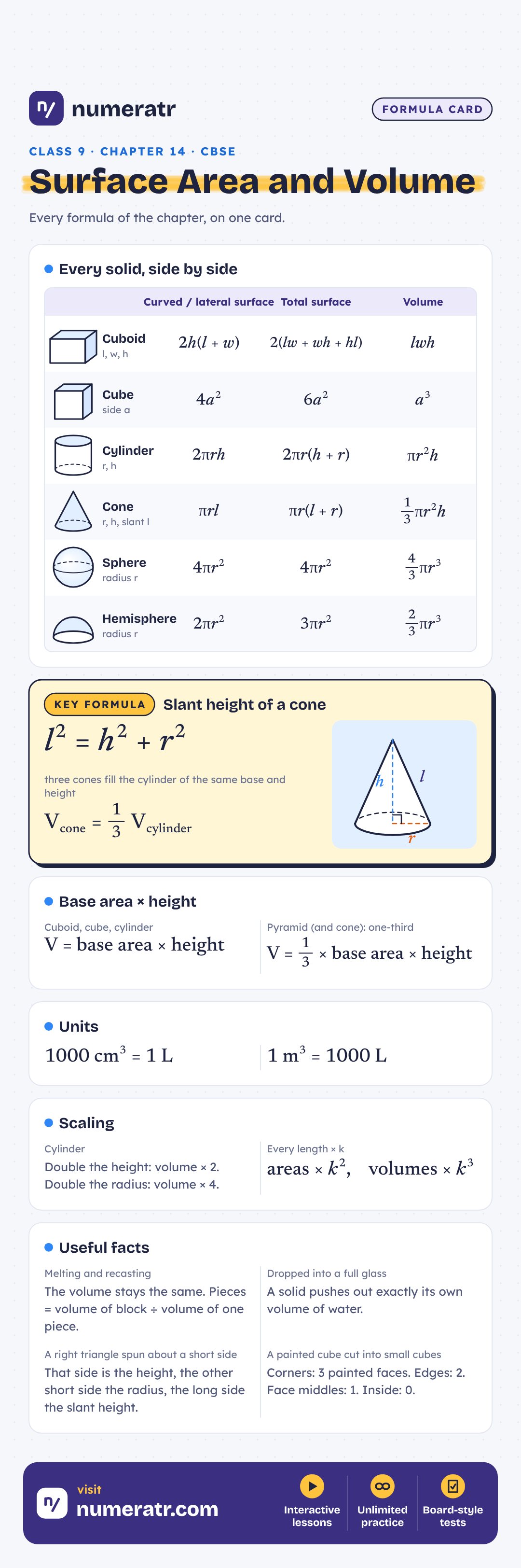
Free to share with friends and study groups.
Learn, practise, test
Every chapter on Numeratr follows the same three steps.
- 1Learn
Short stories and animated pictures explain each idea. After every idea, your child tries a question.
- 2Practise
Practice that adapts from Easy to Challenge, by pattern, or ten at a time. Hints and a full solution for every question.
- 3Test
An exam-style chapter test, sections A to E in the CBSE paper pattern. Fresh numbers every time.
Try three questions
From a starter to a challenge. Have a go before you open the answer.
Find the volume of a cylinder of radius 7 cm and height 6 cm. Use π = 22/7.
Show the answerHide the answer
924 cm³
- Base area = 22/7 × 49 = 154 cm².
- Volume = 154 × 6 = 924 cm³.
A metal cuboid 22 cm × 8 cm × 7 cm is melted and recast into a cylinder of radius 7 cm. Find its height. Use π = 22/7.
Show the answerHide the answer
8 cm
- Volume of the cuboid = 22 × 8 × 7 = 1232 cm³.
- Base area of the cylinder = 22/7 × 49 = 154 cm².
- Height = 1232 ÷ 154 = 8 cm.
The radius of a sphere is increased by 50%. By what percentage does its volume increase?
Show the answerHide the answer
237.5%
- The radius is multiplied by 1.5, so the volume is multiplied by 1.5³ = 3.375.
- The increase is 3.375 − 1 = 2.375 times the old volume, that is 237.5%.
Learn Surface Area and Volume the right way
Interactive lessons, endless practice that adapts, and tests with a fresh paper every time. Children earn NerdCoins for real effort, and parents get a clear report.
One chapter in every class is free.